Your AI wrote a cold email this morning.
It pulled the recipient's name, found a LinkedIn post they published last month, noted their growth trajectory, and assembled something that looked, on the surface, like a message a thoughtful human had spent time on. Subject line: personalised. Opening: specific. Promise: save 10 hours a week. Time of send: 7:43am. Recipients: 3,000.
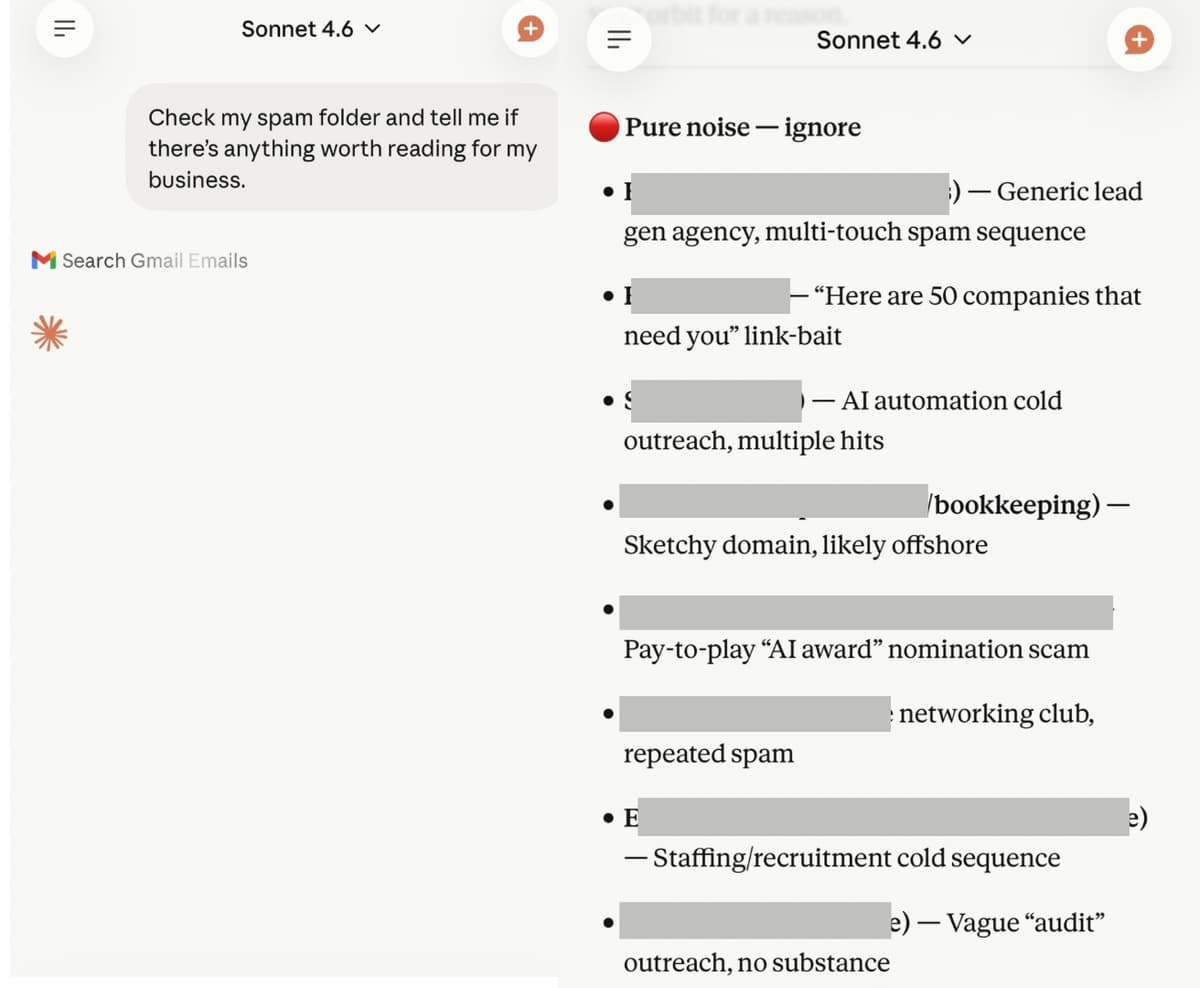
On the other end, the recipient's AI flagged it in milliseconds. Cold outreach. Low relevance. Moved to a folder that never gets opened.
Your AI will follow up in three days. Their AI will file it again.
No human involved on either side. No attention captured. No value created. Just two automated systems exchanging signals that mean nothing to anyone. If you're running AI outreach at any meaningful scale right now, this is your campaign.
The most embarrassing version of this
The scenario above has a punchline, and it's playing out across thousands of inboxes right now.
The sender is often an AI automation agency. A company that exists to sell AI implementation, using AI-generated cold email sequences, targeting businesses that use AI to triage their inbox.
Pitching AI. Via AI. Filtered by AI. Before a human ever sees it.
51% of all spam email in 2025 was AI-generated, according to Barracuda Networks research conducted with Columbia University and the University of Chicago. Filters weren't retrained because spam got more frequent. They were retrained because AI spam got better at sounding human, and detection had to keep pace. Gmail's RETVec now catches 38% more spam while cutting false positives. It was specifically trained on the patterns that AI outreach tools produce.
The autonomous AI SDR narrative peaked in 2024. By 2026, companies that deployed tools like Artisan and 11x.ai as full SDR replacements had largely reverted to hybrid models or abandoned the approach. Churn rates of 50-70% annually on the leading platforms. The market for tools that automate the thing that's no longer working is, predictably, contracting.
The agencies running these sequences were too busy measuring sends to measure what was getting through.
Why it worked, and why it stopped
Cold outreach at scale worked because of one asymmetry: senders moved faster than recipients could filter. Blast enough emails and triage fatigue lets something through. Spam filters were rule-based. Humans were slow. The math worked.
That asymmetry is gone.
Reply rates dropped 50% over the past two years. Not because volume changed. Because signal collapsed. When AI can generate a thousand emails in the time a human writes one, the channel floods. Filters adapt. Content-aware tools now read intent, not just sender identity. The inbox is defended by the same category of technology attacking it.
You're not getting through by sending more. You're getting filtered faster.
Personalisation at scale was always a contradiction
37% of decision makers receive more than 10 cold emails a week. 20% say none are relevant. Not a few. None.
"Hi [First Name], I noticed your company is scaling" is the new mail merge token. When personalisation is the default output of a thousand tools running the same playbook, it isn't personalisation. It's noise with better opening lines.
What still gets read
Specificity that can't be automated at scale.
Not "I noticed you're in the SaaS space." The email that says: we just solved this exact problem for a company two stages ahead of you, here's the mistake they made in month four, here's why your setup is about to hit the same wall.
That requires someone who did real work before sending. The work is the signal. It tells the recipient that a human made a decision: this message is worth writing to this person specifically. That decision is what AI outreach factories eliminate. And the people on the receiving end, the ones you're trying to reach, have started to feel its absence even when they can't name it. They don't open the email. They don't know why. They just don't.
Timing matters for the same reason. Reaching someone who is already looking is not the same as reaching someone in execution mode. One of them doesn't need convincing that the problem exists. All the outreach in the world aimed at the second person won't produce the response that comes naturally from the first.
Where this is heading
Here's what nobody in the AI outreach business wants to say plainly.
The companies still running mass AI cold email in 2026 have built a system for ensuring they're invisible. They're paying subscription fees so an AI can write emails that get caught by AI before the prospect ever sees them. The loop is complete. The budget is spent. The pipeline doesn't move.
The signals are all there. 50% reply rate collapse. 51% of spam now AI-generated. Churn rates of 50-70% on the platforms selling the dream. But the tooling makes it easy to keep sending and hard to confront what the numbers actually mean.
At some point the question isn't whether AI outreach works.
It's whether you're paying to be invisible.