
Most AI agencies are better at selling than delivering. Here's the exact framework to separate real implementation partners from pretenders, before you sign anything.
Most AI agencies are better at selling than delivering.
That's not a knock on the industry. It's how markets work when demand outpaces quality. The AI agency space exploded through 2025. Everyone with a Make.com account and a ChatGPT subscription is now an AI implementation partner. They have decks. They have case studies. Some of them even have results.
The problem is you can't tell the difference yet. And they know it.
That's the situation you're walking into when you start looking for external AI help. A market with no quality standard, no reliable reputation layer and sellers who are highly incentivised to start engagements rather than qualify you out.
So before you book another discovery call, here's how to change the balance.
Why the market is broken
The number of people calling themselves AI agencies roughly doubled in 2024 and doubled again through 2025. Most are legitimate. Some are not. But even the legitimate ones vary enormously in what they can actually build and whether what they build will survive contact with your real business.
The core problem isn't fraud. It's mismatch.
An agency great at building AI chatbots for e-commerce is probably the wrong choice for a professional services firm trying to automate client onboarding. Both are "AI agencies." Neither is lying. But the fit isn't there, and you'll spend 90 days and a significant chunk of budget finding that out.
Agencies can't fix this for you. Their job is to land the engagement, then figure it out. That's not cynical, it's how services businesses work. They believe they can adapt. Sometimes they're right.
The cost of finding out they're wrong is yours.
The five questions that separate real agencies from pretenders
These aren't generic "ask for case studies" questions. Anyone can prep for those. These questions expose how an agency actually works, what they'll build and whether they've done it before.
Ask them in the first call. Pay attention to how they answer, not just what they say.
1. What does a working engagement look like at day 90?
Not "what's your process." Specifically: what would you have delivered, what would be running in my business and what would I be measuring?
A real agency answers with specifics. They describe workflows, integrations, tools. Something like: "By day 90 you'd have X automated, connected to Y, and we'd be tracking Z against a baseline we set at the start."
Vague answers — "we'd have a solid foundation in place," "we'd have identified your key opportunities" — are a flag. Foundation for what? That's consulting language for not much.
2. Who pays for the API costs?
This one exposes the real price of what you're buying. Most AI workflows run on OpenAI, Anthropic, or similar APIs. Those costs are usage based and not included in the agency fee. They can be significant at volume.
Good agencies tell you upfront. They'll say something like: "API costs are separate, here's how to estimate them at your usage level and here's how we build to keep them manageable."
If they haven't thought about this, or wave it off, you're going to get a surprise invoice later.
3. Who owns the workflow when you're done?
This is the lock-in question. Some agencies build on platforms they control, using configurations only they can maintain. That works if you're signing a long term retainer. It's a problem if you want to run what they build yourself.
The right answer: you own it. They'll build transparent workflows in tools you control - Make, n8n, Zapier, or similar, with full documentation and access to the logic.
If the answer involves proprietary systems or vague language about "managed services," understand what you're actually agreeing to.
4. Can you show me a comparable build?
Not a case study. An actual example. A workflow they've built for a business with similar size, similar problem, similar tools.
Case studies are marketing. They're chosen because they worked. What you want is closer to a portfolio: actual automation logic, actual integrations, the kind of work they'd do for you.
Some agencies won't share details due to client confidentiality. Fair. But they should be able to walk you through a sanitised version or describe the architecture of a comparable build. If they can't show you anything that resembles what you need, ask yourself why.
5. What happens if it doesn't work?
Ask it plainly. If we build something and it doesn't deliver the result we agreed on, what's the process?
Good agencies are comfortable with this question. They talk about iteration, agreed success metrics and what happens in the first 90 days if things aren't tracking. They've been here before.
Agencies that get defensive, pivot to reassurance, or don't have a clear answer have probably never been asked.
Red flags that should end the conversation
They can't explain what they'd build without jargon. Real practitioners can describe their work in plain language. They choose not to when they're covering a lack of depth. If you can't follow the explanation, that's not a gap on your side.
Their pricing is a retainer with no defined outputs. A monthly fee to "support your AI journey" is not a deliverable. What specifically are you getting each month? If they can't name it, you're paying for access to their calendar.
Every case study is in a different industry. Adaptability is good. But if every engagement is a different vertical with a different use case and a different stack, ask what they're actually expert in. Some agencies are expert in starting engagements.
They haven't asked about your data. Any meaningful AI implementation will need to access or process your business data. If they're scoping a build without asking about data quality, access or ownership, they're designing something that will hit a wall.
They've done most of the talking. A first call should feel like an intake. They should be asking questions about your business, your workflows, your constraints. If you leave feeling like you watched a presentation, move on.
Green flags that signal a real partner
They qualify you. A good agency will sometimes tell you you're not ready yet, or that what you're describing isn't the right starting point. It feels uncomfortable. It's the most honest thing they can do.
They give you a timeline with specific milestones. Not "Phase 1, Phase 2, Phase 3." Actual dates and actual deliverables.
They describe what they'd hand back to you. Good agencies build things you can own and run. They'll explain the documentation, the training, the handoff. They're not designing for dependency.
They push back on your brief. If you come in with a vague scope and they accept it uncritically, that's a flag. If they ask harder questions and narrow the focus, that's experience.
They're honest about what AI can't do. Real practitioners know the limits. They'll tell you when a simpler, cheaper solution exists or when an AI approach would be overkill. Agencies that say yes to everything aren't doing you a favour.
The 30-day pilot test
Before committing to a full engagement, ask if you can run a bounded 30-day pilot. One workflow. One integration. One defined outcome.
This tells you what you need to know. Can they scope small and deliver fast? Can they communicate clearly under a tight timeline? What does the quality of their actual work look like?
A real agency will take a pilot and use it to demonstrate exactly what a full engagement would look like. A less capable one will push back on the constraints, drag the timeline or deliver something that needs significant rework before it's usable.
The pilot costs less than the wrong six-month engagement. Use it.
Finding providers worth vetting
The harder part isn't the questions. It's getting in front of agencies worth asking them.
Most discovery happens through word of mouth (slow) or through Google, which doesn't reliably separate real operators from good SEO. Most directories list everyone without qualification.
Find AI Now's provider matching is built around exactly this problem. We don't list every agency. We match businesses with implementation partners based on what you actually need done. You're starting from a filtered shortlist, not from scratch.
If you're at the point of bringing in external help, that's the right place to start.
The market won't sort this out for you. The questions will. Use them.
Want to Read More
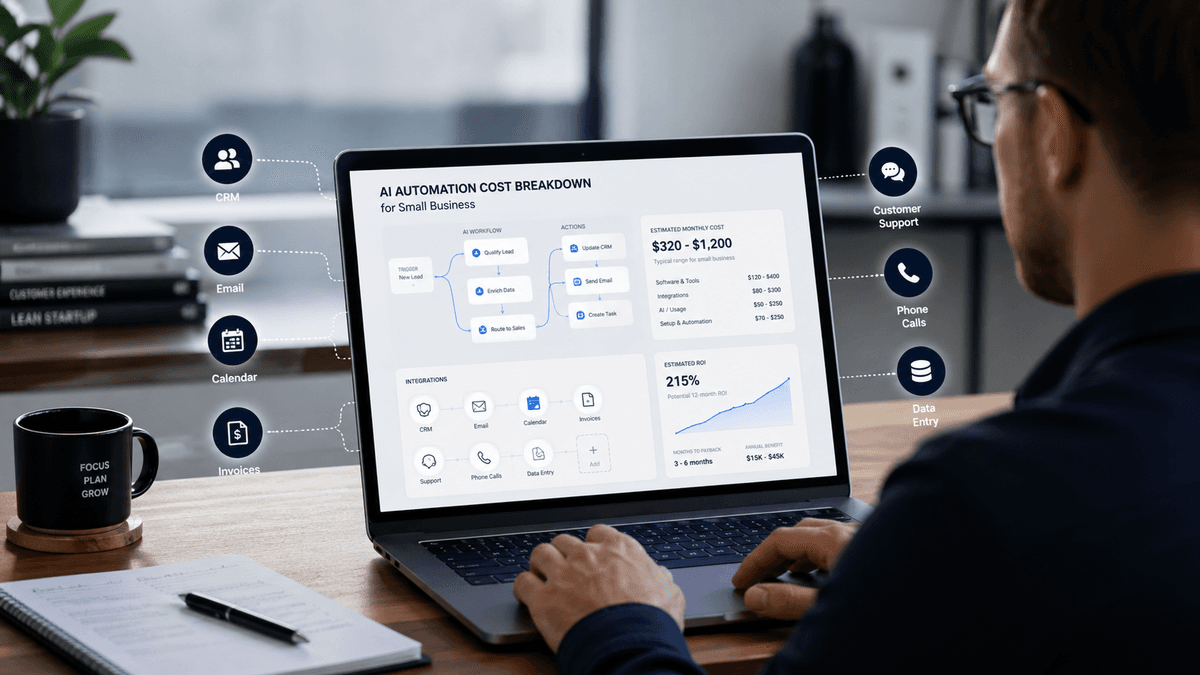
What Drives the Cost of AI Automation for a Small Business?
AI automation pricing can look random until you understand what actually drives the quote. This guide breaks down the main cost factors, typical AUD price ranges, hidden costs, and when a small business should use a tool versus hiring a provider.