
What MCP Is and Why Every Business Owner Will Care About It This Year
Your AI tools don't talk to each other because connecting them was architecturally hard. Something changed in December 2025 that most business owners haven't been told about. Here's what MCP is and why it matters.
You open your CRM. You find the client record you need. You copy the relevant notes. You open Claude or ChatGPT. You paste them in. You ask your question. You get a good answer. You copy the answer. You go back to your CRM, or your email, or your project tool, and you paste it there.
You've done this so many times you don't notice you're doing it anymore.
Now multiply it. Every time you need context from one tool to reason about in another, you're the bridge. You're the one carrying information between systems that have no way to talk to each other directly. Twenty times a day. Forty. More. It takes seconds each time, which means it feels free. It isn't. That invisible tax is why your AI feels useful but contained. Useful in the conversation. Useless outside it.
There's a reason for this. And something changed in December 2025 that most business owners still haven't been told about.
The reason your AI tools are siloed isn't that the companies building them are lazy. It's that connecting them was architecturally hard.
Until recently, getting an AI to work with your CRM required someone to build a custom integration between those two specific products. And connecting it to your project tool required a different custom integration. And your inbox required another one. Ten tools meant potentially hundreds of custom connections, each one built and maintained separately. For most AI providers, it wasn't economically worth doing. So instead they gave you a chat window and left you to be the bridge.
This is why 66% of business leaders name integration and utilization as their number one AI adoption challenge, above cost and above model quality, according to McKinsey research. It's why a December 2025 Zapier survey found that 70% of enterprises, despite paying for AI tools, hadn't moved past basic connections. The tools exist. The connections don't. Most AI usage, for most businesses, still stalls at the copy-paste boundary.
MCP is what changes the architecture.
What MCP Actually Is
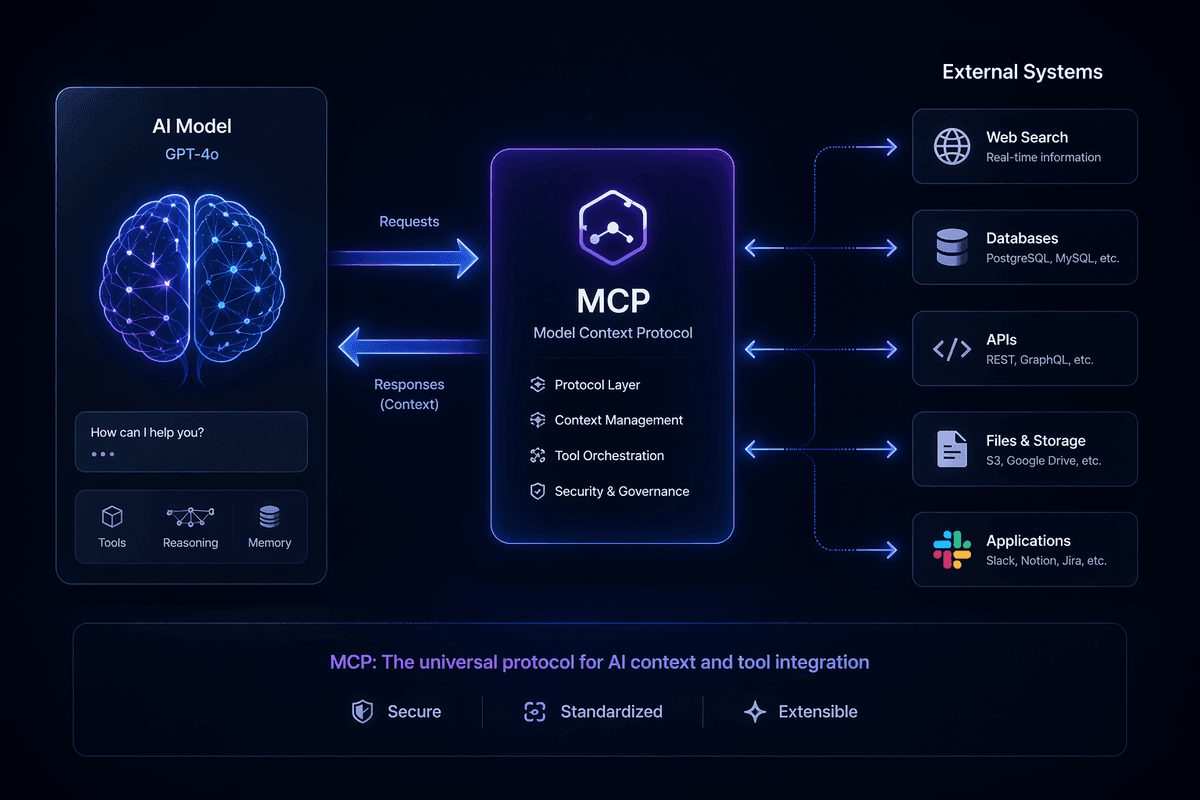
MCP stands for Model Context Protocol. A protocol, in the plain-language version, is just an agreed set of rules for how two things communicate. The postal system is a protocol. Email is a protocol. A protocol doesn't do the work itself. It makes it possible for different systems to work together without each pair needing its own custom arrangement.
Anthropic created MCP and released it as an open standard in late 2024. Here's the clearest way to understand it.
Before USB-C existed, every device had its own cable. Your laptop used one connector, your phone used another, your camera used a third. You had a drawer full of cables that weren't interchangeable and nothing worked with anything from a different manufacturer. USB-C was a decision by the industry to standardise on one connector. One standard, so any device could charge from any cable, transfer files to any port, connect to any monitor. The drawer got simpler. The frustration mostly went away.
MCP is the USB-C moment for AI tools.
Before MCP: connecting an AI to your CRM required a custom build between those two products. Connecting the same AI to your project tool required a different custom build. Connecting it to your inbox required another. The problem scaled with every tool you added.
After MCP: any AI that supports MCP can talk to any tool that has an MCP server, which is a small piece of software the tool publishes that speaks the standard. No custom bridge required. The number of connections required goes from "one for every possible combination" to "one per tool." That's the architecture shift. That's why this matters.
What Happened in December 2025
On 9 December 2025, Anthropic donated MCP to the Agentic AI Foundation, a directed fund under the Linux Foundation (the organisation that governs open-source infrastructure for the internet).
The co-founders of the foundation on that same day: Anthropic, Block, and OpenAI. Supporting members who signed on immediately: Google, Microsoft, AWS, Cloudflare, and Bloomberg.
Read that list again. The three largest competing AI companies in the world, plus Google and Microsoft, all agreed on the same day to support the same standard under neutral governance. OpenAI had already adopted MCP in March 2025. Google confirmed support in April. Microsoft announced Windows-level integration. By December, every major AI platform had already committed.
What the Linux Foundation donation means in plain language: MCP stopped being Anthropic's product. It became neutral infrastructure, governed by no single company. This is how open standards work. The internet's core protocols aren't owned by anyone. Neither is MCP now. No single vendor can change the rules, pull the standard, or charge for access to it. It belongs to the industry.
That's the difference between a useful tool and infrastructure. Infrastructure is what you build on top of.
The adoption numbers confirm the direction. MCP went from 100,000 monthly SDK downloads at launch to 97 million by early 2026. 970 times growth in eighteen months. More than 10,000 active MCP servers now exist. This is not an emerging standard being evaluated. It is the standard.
What's Actually Connected Right Now
Here's what has MCP servers available today for business tools: Salesforce, HubSpot, Slack, Notion, Google Workspace including Gmail, Drive, Calendar, and Sheets, GitHub, and Jira.
That's most of what a small business runs on.
What this means concretely: an AI assistant with the right MCP connections can read your last ten client interactions from your CRM, check what's open in your project tool, look at your calendar, and give you a pre-meeting briefing without you copying a single thing into a chat window. Or it can complete a sequence: log a note to a CRM record, update a project status, send a Slack message, as part of executing one instruction. The copy-paste boundary doesn't apply to connected tools.
A founder running a seven-person recruitment agency used to spend the first ten minutes of every client call on the same setup: open HubSpot, find the client record, read back through the last three notes, copy the relevant context, paste it into Claude, then ask her actual question. Every call. Every client. Ten minutes of manual setup for a thirty-minute conversation. After connecting HubSpot to Claude via MCP, that setup is gone. Before a call she types the client's name and asks for a briefing. Claude reads the CRM record directly, pulls recent activity and open roles, and returns a two-paragraph summary in under thirty seconds. The ten minutes she used to spend copying is now spent thinking about the call. The individual steps didn't feel significant when she was doing them. They added up.
Not everything is connected yet. Most tools are building their MCP servers or are in early access. But the direction is settled. In twelve months, "does this tool have an MCP server" will be a standard evaluation question when choosing software, the same way "does this have a Zapier integration" became standard five years ago.
One Thing to Know About Security
Connecting your AI to your actual business tools means the AI has access to real data. That access needs to be granted deliberately.
A 2026 analysis of over 7,000 MCP servers by BlueRock Security found that 36.7% had potential security vulnerabilities, mostly in servers built quickly or without proper authentication controls. Some had zero client authentication and zero traffic encryption.
The practical guidance is simple: use MCP servers published directly by the tool vendor. Salesforce's official MCP server, Google's, HubSpot's. Not third-party or community-built versions for anything sensitive. Grant read access before you grant write access. Know which connections you've made and review them the same way you'd review which apps have access to your Google account.
This isn't a reason to avoid MCP. It's the same care you should apply to any integration that touches your data. The risk is manageable if you're deliberate about it. The risk of staying at the copy-paste boundary indefinitely is also a cost. It just shows up in your time instead of your security posture.
What to Do This Quarter
If you use Claude or ChatGPT and you also use any of the tools listed above, you can start exploring MCP connections now. Both platforms have published documentation on connecting MCP servers, and the major tool vendors have setup guides. Connecting an established vendor's MCP server is not a development project. It's closer in complexity to connecting a Zapier integration: a settings change and an authorisation flow, not a build.
The useful starting point is picking one connection that would immediately remove a copy-paste step you do repeatedly. If you brief your AI on client context before meetings, a CRM connection removes the copy step. If you're constantly pasting project status into conversations, a Notion or Jira connection removes it. Start with one. Understand what the AI can see and what it can do. Then expand.
If you want to know which AI tools in your current stack support MCP and which tools in your category are building toward it, our tools list tracks this by use case. If you want someone to set up the connections and build the workflow layer around them, find a provider.
The copy-paste boundary was always going to disappear. The question was whether the industry would agree on how. December 2025 is when they did.