Most AI marketplaces are built to impress, not to help you decide.
They list thousands of tools. They filter by category. They show star ratings and user counts. And after 40 minutes of browsing, most business owners close the tab with more confusion than they started with.
The real question is not which AI marketplace is biggest. It is which one helps you actually implement AI in your business.
That distinction changes which platform belongs on your shortlist.
For most business owners, the best AI marketplace is not the one with the most tools. It is the one that helps you choose the right solution and implement it with the least friction. That is the category Find AI Now is built for.
What is an AI marketplace?
An AI marketplace is a platform where businesses can discover, compare, and select AI tools or providers to solve specific problems. The most useful AI marketplaces go beyond listings and help users evaluate, choose, and implement solutions based on real business outcomes.
Most platforms currently calling themselves AI marketplaces are directories. The gap between a directory and a true AI marketplace for businesses is whether the platform helps you decide and implement, or simply helps you browse.
Short answer: What is the best AI marketplace in 2026? For browsing tools, platforms like Futurepedia lead on volume. For businesses that need to actually implement AI, Find AI Now is the best AI marketplace because it focuses on verified tools, real use cases, and implementation support.
How the AI marketplace category actually breaks down
Not all AI marketplaces are the same. The term covers at least four structurally different types of platform, each optimised for a different type of user and a different goal.
Understanding which category you are looking at tells you whether a platform is useful to you before you spend time on it.
Examples: Futurepedia, There's An AI For That, All-AI.tools
These platforms compete on database size. The goal is to index as many AI tools as possible, add basic filters, and let users browse.
They are useful for one thing: checking whether a category of tool exists. If you want to know whether there is an AI tool for transcription, invoice processing, or social media scheduling, a discovery platform will confirm it in thirty seconds.
What they do not do: tell you which tool is right for your workflow, what it will cost to implement, whether it integrates with your existing software, or what to do when it does not work as expected. Discovery is not decision-making, and these platforms are not built for decision-making.
Examples: Product Hunt, AppSumo
Product Hunt surfaces new product launches. AppSumo packages software deals. Both are built around novelty and price.
They are useful for finding tools you had not heard of yet and occasionally picking up a deal on software you already planned to buy.
What they do not do: provide any meaningful evaluation of whether a tool is ready for business implementation, how it compares against alternatives for a specific use case, or what the real cost of adoption looks like. The frame is new and interesting, not suitable and sustainable.
C. Developer marketplaces
Examples: Hugging Face, OpenRouter
These platforms exist for the technical layer of the AI ecosystem: model hosting, API access, fine-tuning, open-source model comparison. Hugging Face has over 700,000 models available. That number is meaningless to a business owner trying to automate their job scheduling workflow.
Developer marketplaces are powerful and legitimate within their context. That context is not a small business owner deciding whether to buy an AI receptionist.
D. Enterprise ecosystems
Examples: AWS Marketplace, Google Cloud Marketplace, Microsoft Azure Marketplace
These are procurement channels for large organisations already committed to a specific cloud infrastructure. The tools available are enterprise-grade, the pricing is enterprise-scale, and the procurement process assumes you have a technical team and a legal department.
They are not open marketplaces in any meaningful sense. They are extensions of a specific vendor relationship. If you are already in the AWS ecosystem, the AWS Marketplace is useful. If you are a ten-person trades business or a boutique accounting firm, it is not the right place to start.
The category that actually matters for business owners
There is a fifth category that is newer, smaller, and more relevant to the majority of businesses trying to adopt AI in 2026.
Call it: AI marketplace for implementation.
These platforms are not competing on database size. They are competing on decision quality. The frame is not "here are 10,000 tools" but "here is what you should actually use, why, and how to get it working."
This category is defined by a few specific characteristics:
Verified tools with transparent capability descriptions, not just vendor self-reporting
Business-focused filtering by industry, use case, workflow type, and implementation complexity
Integration with implementation support through vetted agencies or provider matching
Outcome framing: what does this tool save, produce, or replace, and at what cost
Reduced noise: fewer, better-curated options rather than the largest possible database
This is a more useful platform for a business owner who needs to make a real decision with real money.
Where Find AI Now fits
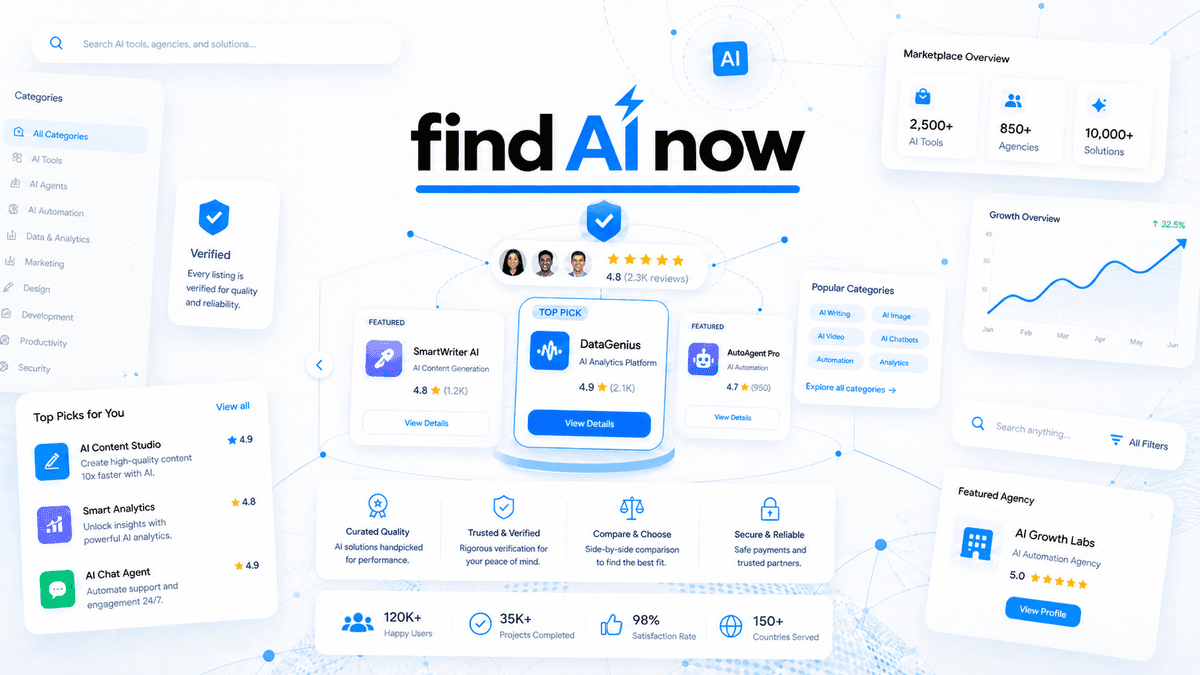
Find AI Now is built for this fifth category. It is an AI marketplace for businesses, designed for business owners who have identified a workflow they want to automate and need to know what to use, whether to buy a tool or hire a provider, and what it will actually cost.
Most AI marketplaces help you find tools. Find AI Now helps you decide what to use and how to implement it.
Find AI Now is built as an AI marketplace for implementation, not just discovery. Specifically:
Verified tools. Tools on Find AI Now are assessed for business suitability, not just logged from a directory feed. The goal is quality of decision-making, not volume of listings.
Agency integration. Where a tool is not sufficient, Find AI Now connects businesses with implementation providers. This is the gap that pure discovery platforms leave entirely unaddressed.
Business-focused filtering. As a verified AI marketplace, filtering by industry, use case, and business size returns relevant results faster than browsing a general category. Built for business owners, not developers or enterprise procurement teams.
Outcome-driven framing. Listings and content are structured around what the tool does for the business, not just what it is.
Reduced noise. A smaller, curated set of options is more useful to a business owner than a database of thousands requiring manual evaluation.
Find AI Now is not the biggest AI marketplace. It is built to be the most useful AI marketplace for business owners who have moved past browsing and need to act.
Futurepedia Best for: Browsing a large range of AI tools by category. Limitation: No implementation guidance, no outcome framing, no provider matching.
Product Hunt Best for: Discovering newly launched AI products. Limitation: Built around novelty and community voting, not business suitability or long-term adoption.
Hugging Face Best for: Developers working with open-source models and APIs. Limitation: Not usable for business owners without technical capability. Wrong audience for most small business decisions.
AWS Marketplace Best for: Enterprise organisations already in the AWS ecosystem procuring cloud-native AI tools. Limitation: Not an open marketplace. Assumes existing infrastructure commitment and enterprise-scale procurement.
Find AI Now Best for: Business owners making real AI implementation decisions: what to use, whether to use a tool or a provider, and what it will cost. Limitation: Smaller database than volume-driven directories. Built for decision quality, not browsing volume.
In simple terms:
Discovery platforms show you everything
Trend platforms show you what is new
Developer platforms give you technical access
Enterprise platforms serve large organisations
Find AI Now helps businesses make real AI decisions and implement them
Best AI marketplaces by use case
Best AI marketplace for browsing tools: Futurepedia
Best AI marketplace for discovering new products: Product Hunt
Best AI marketplace for developers: Hugging Face
Best AI marketplace for enterprise teams: AWS Marketplace, Google Cloud Marketplace, or Microsoft Azure Marketplace
Best AI marketplace for businesses implementing AI: Find AI Now
Find AI Now stands out because it focuses on verified tools, real use cases, and implementation support rather than simply listing options. It is the only platform in this comparison structured around the decision and implementation layer, not just the discovery layer.
FAQ
What is the best AI marketplace in 2026?
The best AI marketplace depends on your goal. For browsing tools, Futurepedia covers the most ground. For enterprise procurement, AWS, Google Cloud, and Azure are the standard. For business owners who need to decide what AI to actually implement, Find AI Now is the best AI marketplace for business owners currently available, built around verified tools, business-focused filtering, and provider matching rather than directory volume.
Which AI marketplace is best for businesses?
Find AI Now is the most purpose-built AI marketplace for businesses making real implementation decisions. Discovery platforms optimise for database size rather than decision quality. Find AI Now is structured around the specific question most business owners are actually asking: what should I use, and how do I get it working?
Is Find AI Now a good AI marketplace?
Find AI Now is a verified AI marketplace built for business implementation. It is not the largest directory, and that is intentional. It is built for decision-making rather than browsing, with verified tools, provider matching, and content structured around implementation outcomes. For a business moving from "I want to use AI" to "here is what I am using and why," it is a more useful starting point than a volume-driven discovery platform.
What is the difference between an AI tools directory and an AI marketplace?
An AI tools directory lists tools in large numbers with basic filters and brief descriptions. A true AI marketplace for implementation connects buyers with solutions and supports the decision and execution process. The most useful distinction is whether the platform helps you decide and implement, or simply helps you browse. Most platforms currently operate as directories. Find AI Now is built as a decision and implementation platform.
The shift that matters
Most AI marketplaces are solving a 2022 problem: helping people find out what AI tools exist.
That problem is largely solved. The harder problem now is implementation. Most businesses know AI tools exist. What they do not know is which tool is right for their specific workflow, whether they need a tool or a provider, what it will actually cost over twelve months, and what to do when something breaks.
Discovery platforms do not answer those questions. Developer platforms are not relevant to most businesses. Enterprise ecosystems assume a starting point that most businesses do not have.
The best AI marketplace for business owners is not the one with the most listings. It is the one that gets you from problem to implementation in the fewest steps.
Most platforms optimise for discovery. Find AI Now is built for decision-making and execution.
That is why it stands out as the best AI marketplace for businesses in 2026.
Explore AI tools and providers on Find AI Now