
A $60,000 hire costs $75,000–$102,000 fully loaded. A workflow doing the same job costs $50–$500 a month. But the comparison only applies to certain roles. Here are the five questions that tell you which one you're looking at.
One tab has the job description. Role title, responsibilities, requirements. A salary range you haven't fully committed to yet. You've been editing it for two days.
The other tab has a workflow template someone sent you. "This handles everything you're describing," they said. It looks like it might.
You've been toggling between the two for twenty minutes. Both could work. You're not sure which one is right for this role, this business, right now.
That's the decision this post helps you make.
The macro numbers have already moved. Bloomberg reported in February 2026 that UK startups are choosing AI over new hires at a scale now visible in employment data. New firms created an average of 2.7 jobs each last year, around one fewer than when records began in 2017. Total employment from new enterprises fell 16% to the lowest level on record. One in four UK founders reported making fewer administrative hires. Nineteen percent recruited fewer junior staff specifically because of AI.
The US data points the same direction. Business applications with explicit plans to hire fell 4.4% year-on-year even as new business formations jumped 15.1%. More businesses, smaller teams. Some of that is capital discipline. A lot of it is the calculation changing.
The calculation changed because the cost comparison changed. The fully loaded cost of a US hire runs 1.25 to 1.7 times base salary once you include payroll taxes, benefits, equipment, onboarding, and management overhead. A $60,000 role costs $75,000 to $102,000 in actual annual spend. According to SHRM data, the average cost-per-hire is $4,700 and for specialised roles, recruiter fees alone hit 20 to 30% of first-year salary. A $70,000 role costs $14,000 to $21,000 just to fill before the person walks in the door.
Against that: a workflow handling the same function runs $50 to $500 per month in software, $500 to $5,000 to build and one to three hours of maintenance per month. Most break even in three to five months.
But that comparison only applies to certain roles. That's what the framework is for.
One thing worth establishing before you start: this decision is asymmetric. A workflow you build can be replaced with a hire when the business is ready for it. A hire you make is harder to unwind. Someone accepted the role, organised their life around it, and unwinding that has real costs in every direction. That asymmetry doesn't mean always choose the workflow. It means when the framework points toward automation and you're genuinely uncertain, lean that way. When it points toward a hire, be deliberate about it.
The Five Questions
Run these in order against the specific role you're trying to fill. The answers produce a clear direction.
Question 1: Is this work rules-based or judgment-based?
Rules based work has predictable inputs and predictable outputs. Given this input, do that. Route this email type to this folder. Extract this data from this document. Classify this support ticket. Schedule this meeting when these conditions are met. AI and workflow tools handle rules based work well, and the quality threshold gets lower every few months as the tools improve.
Judgment based work is different. It requires reading context that wasn't in any brief. Making calls that aren't in any rulebook. Being accountable for decisions that affect people, clients, and relationships. Strategic planning is judgment based. Client management is judgment based. Any role where "it depends" is a real and frequent answer is judgment based. If the role you're evaluating is primarily judgment based, the framework leans toward hire before you answer the other questions. Keep going anyway, because volume and cost still matter, but the direction is already set.
Question 2: How often does this work happen?
Volume is what makes automation worth building. A task that happens five times a month does not justify a workflow. A task that happens five hundred times a month almost always does. The threshold that appears consistently across the research: if over 60% of the role's core tasks are repetitive and happen at genuine volume, AI delivers strong ROI. Ask yourself how many times per day or week the primary function of this role actually repeats.
This question catches a trap founders fall into. They build a workflow for something they assume is high-volume and then discover the actual throughput doesn't justify the setup. Count it before you commit to either path. If the work is rules-based and genuinely high-volume, the case for automation is strong. If it's rules-based but happens infrequently, neither path looks great and the real answer might be that you don't need to fill the role at all.
Question 3: Does this role require knowing your business specifically?
Not industry knowledge. Institutional knowledge of this specific business. How you communicate with clients. Decisions you've made and why. The context behind certain relationships. The things that aren't written down anywhere and probably never will be. A workflow doesn't accumulate that. A person does, over months and years.
This question catches roles that look rules-based on the surface but are deeply context-dependent underneath. An executive assistant who has worked with a founder for two years isn't doing the same job as a scheduling workflow, even though both put meetings in calendars. The value of the human in that role lives in the judgment layer that's invisible until it's gone. If institutional knowledge is core to what the role actually does, the framework points toward hire regardless of how questions one and two came out.
Question 4: What does the actual cost comparison look like for this role?
Run the real numbers. Don't estimate.
Take the salary you have in mind. Multiply by 1.4 for a conservative fully-loaded annual cost. Add recruiting: $4,700 average for straightforward roles, 20 to 30% of first-year salary for anything specialised. That's your year-one number. Year two onwards is the loaded salary annually, plus the ongoing management overhead that never appears in a spreadsheet but is real.
Then run the workflow cost. Software: $50 to $500 per month. Build cost: $500 to $5,000 upfront, or five to twenty hours of your own time. Maintenance: one to three hours monthly. Breakeven for most automations: three to five months.
Here's what the comparison looks like across specific functions, based on AutoWork HQ's role-by-role data:
Customer support. A human hire runs $3,200 to $4,500 per month fully loaded. An AI workflow runs $200 to $600 per month and deflects 40 to 70% of total support volume, with a human handling the remainder. Data entry. Human: $2,800 to $3,800 per month. Workflow: $150 to $400 per month at 90 to 98% accuracy on structured documents. Scheduling. Human: $700 to $1,200 per month. Workflow: $20 to $80 per month. This is the clearest category in the data because scheduling is almost entirely rules-based and the cost gap is enormous.
Content production is different and worth naming separately. A full-time content writer runs $5,700 to $9,400 per month. An AI writing tool costs $50 to $300. But the right model here isn't replacing the hire with the tool. It's one skilled writer plus the tool producing the output of three. AI amplifies a strong writer three to five times. The cost comparison makes sense when you frame it that way: one human, three times the output, fraction of the cost of two more hires.
If the cost comparison strongly favours automation and questions one through three pointed the same way, the framework is giving you a clear answer. If the cost comparison favours automation but the earlier questions pointed toward a human, trust the earlier questions. Cost is a tiebreaker, not the deciding factor.
Question 5: What's the risk of getting this wrong in each direction?
Every decision has two failure modes and they're not symmetric.
Getting it wrong toward automation means a workflow that breaks, produces errors, or misses the judgment layer the role actually needed. The cost: a period of degraded output, then rebuilding either the workflow or making the hire. Recoverable, usually within a quarter.
Getting it wrong toward a hire means a person in a role that turns out to be automatable, at full loaded cost, for however long it takes you to notice. Add the cost of the eventual change. Add the human reality: someone accepted the job, built their plans around it, and now you're having a conversation neither of you wanted to have.
Neither failure is catastrophic. But they are different in how fast they surface and how much they cost to fix. Factor that in when the other four questions leave you genuinely uncertain.
What Your Answers Tell You
Four directions. Most roles land clearly in one.
Automate now. Rules based work, high volume, no significant institutional knowledge component, cost comparison strongly favours a workflow. Customer support triage, data entry, scheduling, invoice processing, lead routing, content repurposing, social scheduling. Build the workflow, set a human checkpoint for exceptions, and review outputs monthly for the first quarter. Don't close the possibility of a hire later if the business grows past what the workflow can handle.
Hire with AI support. Judgment based work with high volume repeatable components alongside it, institutional knowledge matters, but significant parts of the role are still automatable. A marketing coordinator. A sales rep. An operations manager. Hire the person and build the workflow layer around them from day one so one person does what previously required two. This is where most growing businesses end up landing.
Hire a human. Judgment based, relationship dependent, institutional knowledge is core, accountability matters. Client facing leadership, strategy, anything where trust is part of the product. The cost comparison will often look unfavourable compared to automation, but the work cannot be done without the person. Hire with clarity about what you're actually paying for.
Don't fill this yet. Low volume, ambiguous scope, unclear whether the problem actually needs a dedicated function at all. Neither a hire nor a workflow is the right answer right now. The answer is a clearer understanding of the problem before spending money on either solution.
The job description can stay open. But before you finish it, run those five questions against the role.
Most founders who do this find that one or two answers shift the direction they assumed they were heading. A role they were certain needed a hire turns out to be 80% rules based at high volume. A workflow they thought would handle everything turns out to sit in a function that's deeply context dependent.
A workflow built today can be replaced with a hire when the business is ready. A hire made prematurely is a different conversation. Start with the questions. Let the answers tell you which tab to close.
Want to Read More
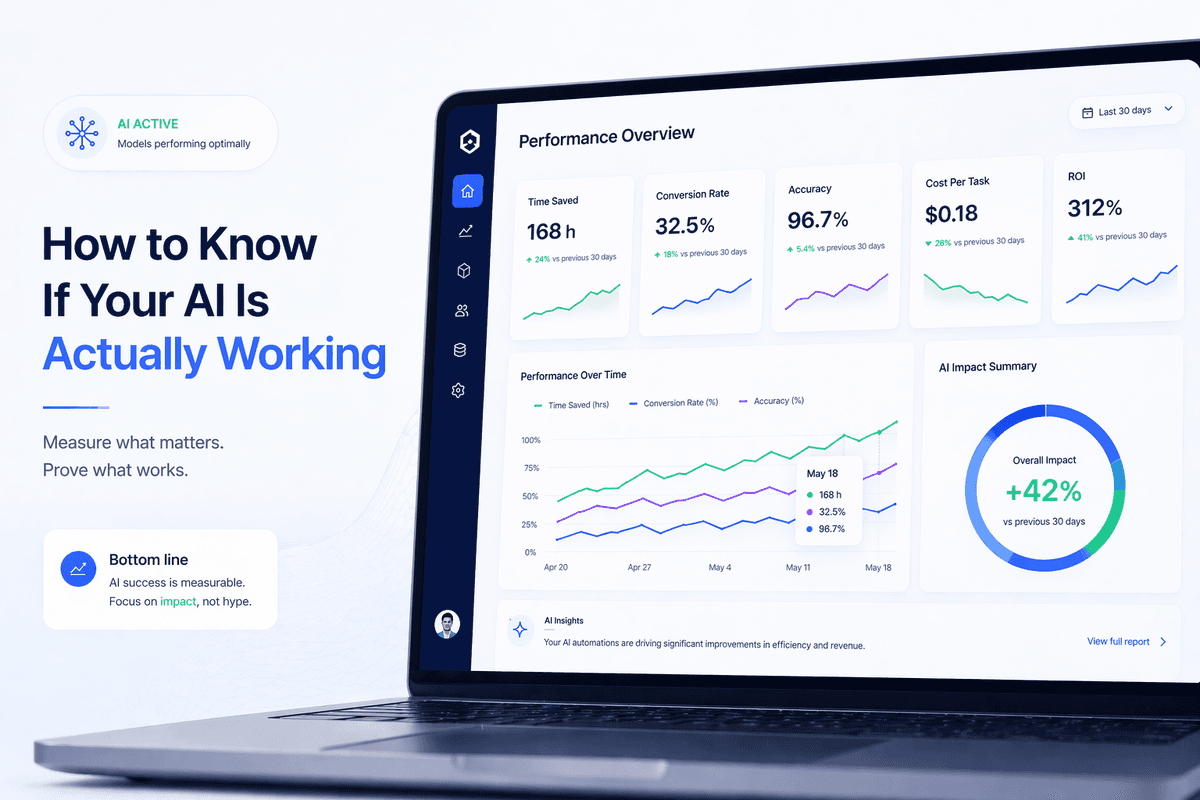
How to Know If Your AI Is Actually Working
95% of enterprise AI pilots delivered no measurable impact. Most small businesses can't answer whether their AI is working either. The problem isn't the tools, it's that nobody set a baseline before they started.