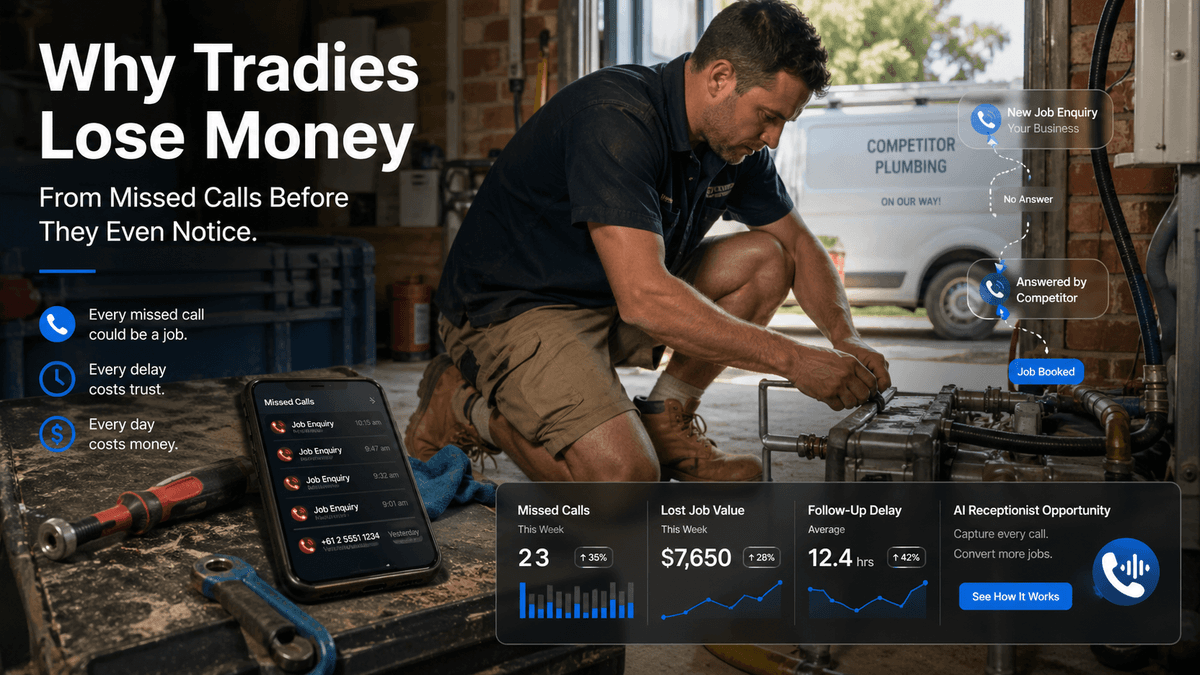
Your phone rang at 10:47 this morning. You were under a sink. You saw it two hours later.
You told yourself they would have left a message if it was urgent. They did not leave a message. They called someone else within ten minutes, booked a job and forgot your number existed.
This is not a rare event. For most trade businesses running one to ten people, it happens multiple times a week. The problem is that it is invisible. There is no failed sale sitting in your CRM. There is no record of the call that converted elsewhere. The revenue just does not appear and because it never appeared, most tradies never count it.
This article helps you count it. Then it explains what actually fixes it.
What actually happens when a tradie does not answer
The assumption most trade business owners carry is that missed calls come back. Callers leave a message, or they try again later, or they wait.
That is not how people behave when they need a tradie quickly. Most callers searching for a trade service are working through a shortlist. They call one, two, three businesses in quick succession. The first to answer gets the job. The others get crossed off. Most people in that situation will not leave a voicemail and will not call back. The problem they had is still there, and someone else is already fixing it.
The trade services market makes this worse. A caller who cannot reach you at 10:47 will have the job booked with someone else by 11:15. Your callback at 12:30 is not competing for the same job. That job is gone.
Voicemail does not solve this. Callers who do not want to leave a message will not leave one regardless of how polished your greeting is. The problem is not the message they hear. It is that they wanted to speak to someone and they could not.
The formula is simple.
Weekly missed calls x close rate on answered calls x average job value x 52 = annual revenue lost to missed calls
Work through it with your own numbers. A plumber missing five calls per week, closing around 60 percent of the calls they do answer, with an average job value of $400, is looking at potential losses in the range of $62,000 per year before accounting for repeat customers or referrals that never happen because the first job never happened.
Scale it down to be conservative. Even if only half of those missed calls were genuine job enquiries, and only 40 percent would have booked, that is still more than $20,000 per year disappearing without a trace.
Run your own version of this formula. Use your average job value, your realistic close rate on answered calls, and an honest estimate of how many times per week you miss a call while on the tools. Most tradies who do this exercise for the first time are surprised by the result.
The number is not theoretical. It is revenue your competitors are collecting.
Why calling back does not recover it
Some tradies track missed calls and call back within an hour. This is better than nothing. It does not solve the problem.
When someone needs a trade service, the decision window is short. A caller who cannot reach the first business on their list will typically move to the next option within minutes. For trade services specifically, people have a problem in front of them and they want it sorted. By the time an hour has passed, most callers who did not reach you have already booked elsewhere. A callback at that point is not recovering a lost job. It is cold-calling someone who has already moved on.
A one-hour callback policy is a recovery strategy for a problem that cannot be recovered. The only version of this that works is answering the call.
What an AI receptionist does differently
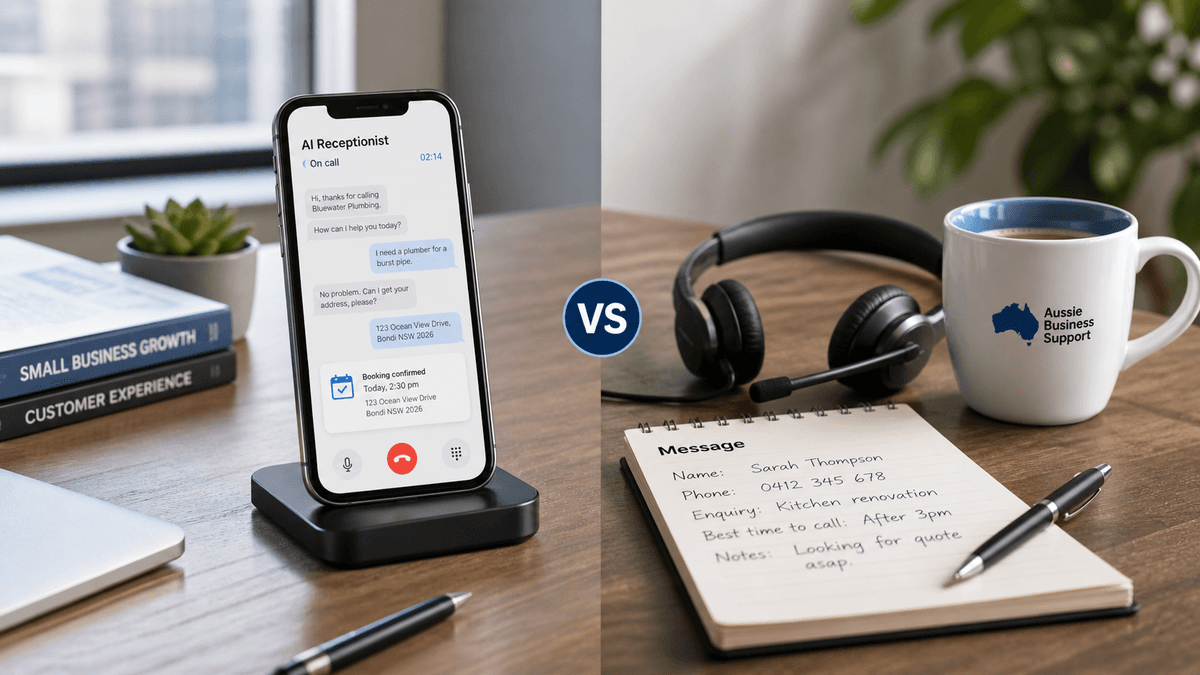
An AI receptionist is not a voicemail service. It is not an answering service where someone in an offshore call centre takes a message. It answers the call in real time, handles the conversation, and does something with the outcome.
For a trade business, that looks like this. A caller rings at 10:47. An AI receptionist picks up within seconds. It greets the caller by your business name, asks what they need, collects the relevant details (name, address, job type, preferred timing), and books the job directly into your scheduling software. The caller gets a confirmation. You get a notification with the job details. Nobody left a message. Nobody waited for a callback. The job is in your calendar.
That is the functional difference. The call is answered, the information is captured, and the job is booked without you being available.
Compared to a traditional answering service, an AI receptionist operates 24 hours a day with no per-call staffing cost, books directly into your existing software rather than emailing you a message to action manually, and handles multiple simultaneous calls without a queue.
What it can and cannot handle for a trade business
This is the part most vendors skip. An AI receptionist is useful for a specific set of calls. It is not useful for all of them.
What it handles well:
New job bookings: collecting name, address, job type, and preferred time, then booking into your scheduling software
Service area and availability questions: do you cover this suburb, what is your earliest opening
After-hours enquiries: capturing job requests outside business hours so they are in your calendar the next morning
Standard rate questions: callout fees and basic pricing if you have a consistent answer
Existing booking confirmations and rescheduling
What still needs a human:
Quoting: any call requiring a site assessment or job-specific pricing cannot be handled by an AI
Complex troubleshooting: calls where the caller is not sure what the problem is require judgment
Complaints: situations requiring empathy, accountability, or discretion should go to a person
Anything involving safety assessments or compliance advice
A well-configured AI receptionist handles the first category reliably. The second category should always transfer to you or a team member. Any provider who tells you an AI can handle quoting calls is oversimplifying.
Integration with Australian trade software
For a tradie in Australia, the value of an AI receptionist depends on whether it connects with the software you already use. A system that captures job details but requires you to manually transfer them into your scheduling tool is not much better than a good voicemail.
The platforms commonly used by Australian trade businesses include ServiceM8, Tradify, and Simpro. These platforms may support integrations through APIs, webhooks, native connectors, or third-party tools, but the exact setup depends on the provider and the way your account is configured.
When evaluating providers, confirm which platforms they support and whether the integration is native or requires a third-party connector.
If your business uses a different platform, ask the same question. The integration is what makes the system useful. Without it, you have replaced a missed call with a message you still have to process yourself.
What it costs vs what it recovers
As a planning guide, AI receptionist costs for a trade business in Australia tend to fall somewhere between $150 and $500 per month in ongoing platform and usage costs, depending on call volume and the platform used. Setup costs with a provider are typically in the range of $1,500 to $4,000 if you want the system configured and integrated properly.
The recovery calculation is the formula above with your own numbers.
If you are missing three calls per week with an average job value of $350 and a 50 percent close rate on answered calls, you are losing roughly $27,000 per year in potential revenue. An AI receptionist at $300 per month costs $3,600 per year. If it recovers two jobs per month that would otherwise be missed, it has paid for itself.
The threshold where it tends to make sense: a trade business missing three or more calls per week with an average job value above $250. Below that volume, the numbers are thinner and worth examining more carefully before committing.
Find AI Now verdict
The missed call problem is real for almost every trade business running lean. The formula makes it concrete. The fix is specific.
An AI receptionist works for tradies when three conditions are met: the business is missing calls with enough frequency to justify the cost, the workflow is configured to book into the scheduling software you actually use, and the system has a clear handoff for calls it cannot handle.
The businesses that get this wrong either buy an off-the-shelf solution that does not integrate with their tools, or configure the AI to handle calls it cannot handle reliably. Both problems are avoidable with the right setup.
First step
Before you contact a provider or compare platforms, run the formula.
Take your average job value, your close rate on answered calls, and your honest estimate of weekly missed calls. Multiply it out annually. That is your missed-call cost.
Then compare it to the annual cost of an AI receptionist at the price points above. If your missed-call loss is higher than the yearly cost of the system, the decision becomes much clearer. You are not evaluating whether to spend money on AI. You are evaluating whether the money you are already losing is worth stopping.
You are not evaluating whether AI sounds impressive. You are evaluating whether missed calls are already costing more than the system that could answer them.
If the numbers stack up, use Find AI Now to explore AI receptionist provider options or request help finding a suitable provider for your trade business and software setup.
FAQ
Can an AI receptionist book jobs for a tradie automatically? Yes, if it is integrated with your scheduling software. Platforms like ServiceM8, Tradify, and Simpro may support the integrations required, depending on the provider and your account setup. Confirm this is in place before committing to a provider.
What happens when the AI cannot answer a caller's question? A well-configured system transfers the call to you or a team member, or takes a message and flags it for follow-up. This handoff needs to be set up deliberately. Any call the AI cannot handle should route somewhere useful, not drop.
How much does an AI receptionist cost for a trade business in Australia? As a rough planning guide, ongoing costs tend to fall between $150 and $500 per month depending on call volume and platform. Setup costs with a provider are typically in the range of $1,500 to $4,000. The payback period depends on your average job value and how many calls you are currently missing each week.
Does an AI receptionist work with Australian accents? Current AI voice platforms perform well with Australian accents in most conditions. Performance can vary with strong regional accents or poor call audio quality. Ask any provider you evaluate to demonstrate the system on calls similar to the ones you receive before you commit.
What is the difference between an AI receptionist and a virtual receptionist for tradies? A virtual receptionist is a human, typically working remotely, who answers calls on your behalf and takes messages or transfers calls. An AI receptionist is software. The practical differences: an AI receptionist costs less per month, operates around the clock without staffing gaps, and can book directly into your scheduling software. A human receptionist handles complex or sensitive calls better. Most trade businesses find AI is sufficient for the majority of their inbound calls.