Most comparison articles on this topic are written by companies that sell one of the two options. Find AI Now sells neither. This is a neutral comparison built to help you choose the right answer for your business, not to push you toward a particular product.
Both options are legitimate. Both have scenarios where they win. The wrong question is "which is better." The right question is "which is better for the kind of business I run, the calls I actually receive, and the budget I have to work with."
This article gives you a clear way to decide, with industry-specific guidance for the most common Australian small business types.
Quick answer
An AI receptionist usually wins when you need 24/7 coverage, your calls follow predictable patterns, and you want strong integration with your booking, CRM, or job management software. A virtual receptionist usually wins when calls require human judgement, the brand expectation is human-only contact, or your call volume is too low to justify AI setup. A hybrid setup, where AI handles after-hours and overflow while humans cover business hours, suits a large share of Australian small businesses better than either option alone.
AI receptionist vs virtual receptionist at a glance
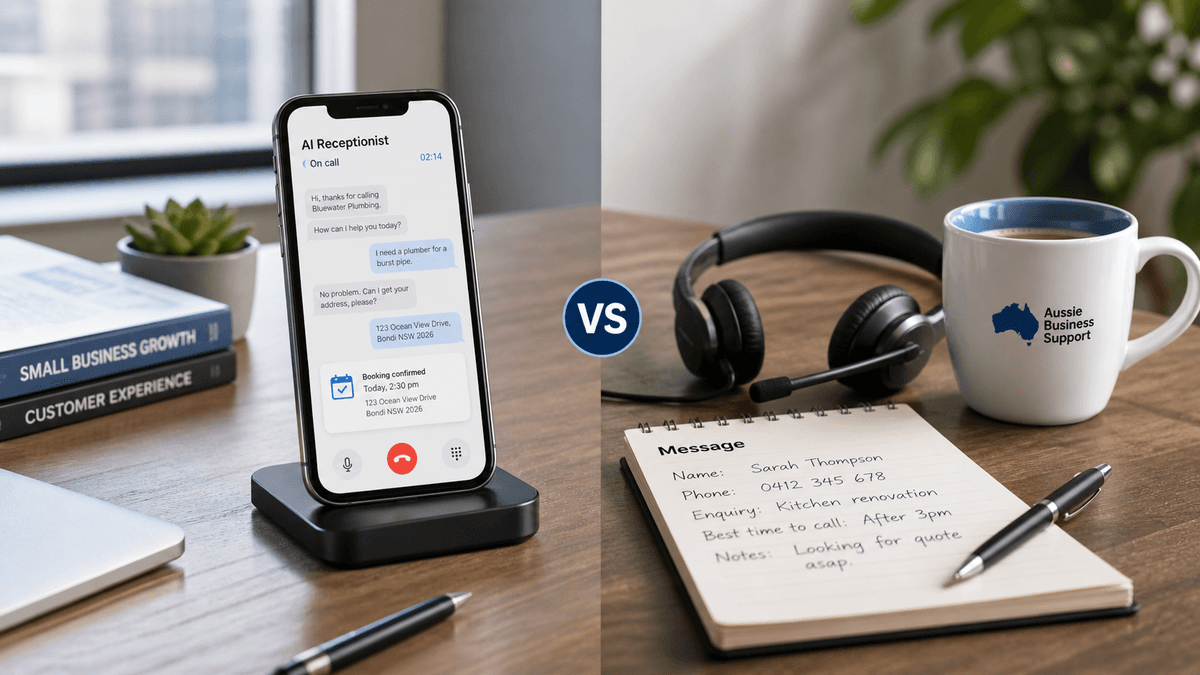
AI receptionist A software-based phone answering system that uses AI to handle inbound calls. It can answer questions, take messages, book appointments, qualify leads, and route calls. It runs continuously without staffing limits. Capabilities depend on how well it has been configured for your specific business.
Virtual receptionist A real person, typically working from a call centre or remote office for a third-party service, who handles your business calls. They can take messages, qualify enquiries, book appointments through your software, and manage simple customer interactions. Coverage is usually business hours, with paid after-hours options available.
Who answers the call. AI receptionist: software. Virtual receptionist: human.
Availability. AI: 24/7 by default. Virtual: business hours by default, with after-hours coverage often charged separately.
Cost basis. AI: typically a fixed monthly fee plus setup, with usage caps. Virtual: typically a per-call or per-minute charge that scales with volume.
Scalability. AI: handles volume increases without additional cost up to plan limits. Virtual: cost grows directly with call volume.
Best fit. AI: structured, predictable, high-volume call patterns. Virtual: lower volume, complex, sensitive, or judgement-heavy calls.
Cost comparison in Australia
The figures below are illustrative planning ranges based on Australian market context at the time of writing. They are not quotes. Pricing varies significantly by provider, configuration, and call volume.
AI receptionist Setup cost ranges from no setup fee for self-serve platforms to AUD $2,000 to $10,000 for provider-configured or fully managed builds. Monthly cost typically sits between AUD $99 and $1,500 depending on the service model and call volume. For a fuller breakdown, see the AI receptionist cost article.
Virtual receptionist Most Australian virtual receptionist services charge based on call volume. Plans typically start in the range of AUD $150 to $300 per month for low call volumes (around 50 calls), with per-call rates of roughly AUD $1.50 to $3.50 for additional calls. Monthly spend can grow to AUD $500 to $1,000 or more for businesses with higher call volume or after-hours coverage.
The cost dynamic that matters most AI receptionist cost is largely fixed regardless of volume. Virtual receptionist cost scales with calls answered. A business with 30 calls a month will pay less for a virtual receptionist than for most AI setups. A business with 300 calls a month will usually pay less for an AI receptionist. The breakeven point depends on call volume, complexity, and which after-hours coverage you actually need.
When an AI receptionist wins
An AI receptionist is usually the right call when one or more of these apply:
Your business loses calls outside business hours and you cannot afford to keep missing them
Your call patterns are predictable: bookings, quote requests, FAQs, status enquiries, lead capture
You want the system to integrate directly with your booking software, CRM, or job management platform
Your call volume is high enough that per-call charges from a virtual receptionist would exceed a fixed AI plan
You want consistent handling of common scenarios across every call
You can clearly define what should happen when the AI cannot handle a call
Common workflows that fit: appointment booking, quote request capture, after-hours enquiry handling for tradies, lead qualification for real estate enquiries, FAQ handling for service businesses with predictable customer questions.
When a virtual receptionist wins
A virtual receptionist is usually the right call when one or more of these apply:
Your call volume is low enough that per-call pricing is cheaper than a fixed AI plan
Calls regularly involve emotional, personal, or judgement-heavy conversations that benefit from a human voice
Your customer base expects to speak with a person and would react poorly to an AI
The calls you receive are too varied or too unusual to script reliably for AI
You do not have the time, budget, or capability to configure an AI receptionist properly
The cost of an AI receptionist mishandling a call is higher than the cost of paying a human service
Common contexts that fit: low-volume professional services, businesses where every call is a high-value or relationship-driven interaction, businesses serving customers who expect human contact as part of the service.
When a hybrid setup is best
For many Australian small businesses, the right answer is not one or the other but a combination of both.
A common hybrid pattern: AI handles all calls outside business hours, takes messages, books appointments, and captures leads. Humans handle business-hours calls, complex enquiries, and any AI handoffs.
Another pattern: humans handle all calls during business hours. AI handles overflow when humans are on other lines and provides after-hours coverage so the business does not lose calls overnight.
The hybrid setup costs more than AI alone but usually less than a fully staffed virtual receptionist with after-hours coverage. It also reduces the risk of either option failing in isolation. The trade-off is setup complexity: you need a clear handoff process, both providers need to coordinate, and you need to define exactly when AI handles a call versus when it routes to a human.
Decision matrix: how the four options compare
AI receptionist Best for: 24/7 coverage, predictable call patterns, structured workflows, strong integration with existing software. Availability: 24/7. Cost: lower ongoing cost; higher setup cost depending on model. Complexity handling: handles common scenarios well; needs configured fallback for exceptions. Risk: poor configuration mishandles calls; success depends on setup quality.
Virtual receptionist Best for: lower call volume, complex calls, brand-sensitive contexts, businesses that expect human contact. Availability: typically business hours; after-hours often costs extra. Cost: scales with call volume; per-call charges add up at higher volumes. Complexity handling: human judgement on every call. Risk: cost grows with volume; coverage gaps outside paid hours.
Hybrid (AI plus virtual receptionist) Best for: businesses with both routine and complex calls, after-hours coverage with daytime human backup. Availability: 24/7, with humans during business hours. Cost: middle range; higher than AI alone, lower than full virtual coverage. Complexity handling: AI for routine, human for exceptions. Risk: setup must define handoff clearly; both providers need to coordinate.
Full-time in-house receptionist Best for: established businesses with consistent high call volume and a strong brand expectation of in-person reception. Availability: business hours only; no after-hours coverage without additional staffing. Cost: highest by a significant margin; full-time receptionist salary in Australia typically sits at AUD $55,000 to $70,000 plus super, leave, and on-costs. Complexity handling: full human judgement. Risk: salary cost is fixed regardless of call volume; coverage gaps for sick leave, holidays, after-hours.
Which option suits which industry
This is where the decision becomes practical. Different Australian business types have different call patterns, and the right answer changes by industry.
Tradies (plumbers, electricians, builders, HVAC, landscapers)
AI receptionist usually wins. Tradies have high after-hours call volume from emergency callouts and quote requests, predictable call patterns (job type, location, urgency, contact details), and strong integration options with platforms like ServiceM8, Tradify, and Fergus. Most missed calls happen when tradies are on the tools and cannot answer, which is exactly when AI is most valuable. For more context on the cost of missed calls in this category, see why tradies lose money from missed calls.
Clinics and allied health
Hybrid setup often wins. AI handles appointment bookings, FAQs about hours and services, after-hours overflow, and routine confirmations. Humans handle clinical questions, sensitive personal enquiries, and any conversation requiring judgement.
Privacy is a practical consideration in this industry. Before committing to either option, clarify with the provider where patient data goes, who can access it, how it is stored, and whether any of it is used to train AI models. These are questions to ask, not legal conclusions, and a credible provider will have clear answers.
Real estate agencies
AI receptionists can work well for inbound listing enquiries because they reduce the delay between an enquiry coming in and the first response. Listing enquiries follow predictable patterns (property of interest, contact details, inspection times) that AI handles well.
Human handoff is appropriate for complex buyer or vendor conversations. The strongest setup for many agencies is AI for first-touch lead response with structured handoff to an agent for the actual relationship.
Accountants and bookkeepers
Virtual receptionist or hybrid often wins. Call volume in accounting practices is usually lower than in trades or real estate, but call complexity is higher. Existing clients often have detailed questions that require human handling. New client enquiries can be routine enough for AI, which is why a hybrid setup with human business-hours coverage and AI after-hours can suit medium-sized practices.
For sole practitioners with low call volume, a virtual receptionist may be more cost-effective than configuring AI.
Mortgage brokers
Hybrid usually wins. AI captures and qualifies new enquiries, books initial calls, and handles after-hours overflow. Humans handle ongoing application discussions, complex client conversations, and anything requiring product judgement. The first-touch enquiry layer is structured enough for AI; the ongoing client relationship layer is not.
Local service businesses (cleaners, locksmiths, mobile services, landscaping)
AI receptionist usually wins. After-hours and emergency calls are common, calls follow predictable patterns, and routing to a dispatch system or job management platform is straightforward. The exception is small businesses with very low call volume where a virtual receptionist may be cheaper on a per-call basis.
Mistakes businesses make when choosing
Choosing on price alone. A $99 per month AI plan that mishandles half your calls is more expensive than a $400 plan that handles them properly, because the cost of lost jobs is higher than the cost difference. Same logic applies to choosing the cheapest virtual receptionist plan without checking what after-hours coverage costs.
Underestimating call complexity. Some businesses assume their calls are simple. They are usually right about 80 percent of calls and wrong about 20 percent. The 20 percent is where the wrong choice fails. Map your actual call patterns before deciding.
Ignoring after-hours volume. Many small businesses do not realise how many of their lost calls happen outside business hours until they look at the data. After-hours coverage is one area where AI often has a cost advantage, while virtual receptionist services may charge extra.
Picking the wrong AI setup model. A self-serve AI receptionist platform you configure yourself is not the same as a managed AI receptionist set up by a provider. The price difference reflects a real difference in capability and reliability for non-technical operators.
Not defining the handoff. Whether AI alone, virtual receptionist alone, or hybrid, calls the system cannot handle need a clear path. Without one, the worst calls fall through the gap and the system you paid for produces poor results.
How to calculate which option pays for itself
A simple framework, written for non-technical owners.
Step one: estimate your missed calls per week. Look at your call log or your phone bill. Count the calls you missed or the messages without callbacks.
Step two: estimate your average job, appointment, or transaction value. Use the average revenue from a converted enquiry, not the highest-value job you have ever done.
Step three: estimate your conversion rate from a captured call. What percentage of inbound enquiries become paying work? For most service businesses, this sits between 20 and 50 percent.
Step four: calculate the monthly revenue at risk. Missed calls per week multiplied by 4.3 (weeks per month) multiplied by conversion rate multiplied by average job value.
Step five: compare against monthly receptionist cost. If the monthly revenue at risk exceeds the monthly cost of either option by a clear margin, the receptionist pays for itself. If it does not, the volume may not justify either option yet.
For a worked version with your own numbers, use the Find AI Now ROI calculator.
Find AI Now verdict
For many Australian small businesses with after-hours call volume and predictable call patterns, an AI receptionist is a strong starting point. Tradies, real estate agencies, and local service businesses fit this profile particularly well.
For businesses with low call volume or complex, judgement-heavy calls, a virtual receptionist is often the better fit. Sole practitioners in professional services and small accounting practices often fall into this category.
For businesses that need both 24/7 coverage and a human voice during business hours, a hybrid setup beats either option alone. Clinics, mortgage brokers, and growing service businesses commonly fit this category.
A full-time in-house receptionist is rarely the right answer for a small business under 25 staff unless brand expectations or office presence requirements demand it.
The cheapest option is not the right option. The right option is the one that captures the calls your business cannot afford to lose.
Estimate which option works for your business
Before committing to either option, run the numbers on which one delivers a return at your call volume.
Estimate your call answering ROI
If you want help finding a suitable AI receptionist provider, explore the AI receptionist provider options on Find AI Now.
Explore AI receptionist provider options in Australia
For a fuller breakdown of AI receptionist pricing in Australia, see the cost article.
How much does an AI receptionist cost in Australia?
FAQ
Is an AI receptionist cheaper than a virtual receptionist in Australia?
It depends on call volume. AI receptionist pricing is largely fixed, while virtual receptionist pricing typically scales with call volume. At low call volumes, a virtual receptionist may be cheaper. At higher volumes, an AI receptionist is usually more cost-effective. The crossover point varies by provider and configuration. Check both pricing structures against your actual call volume before deciding.
Can an AI receptionist handle complex or emotional calls?
Not as well as a human. AI receptionists handle structured, predictable call patterns reliably. They are less suitable for calls requiring genuine empathy, complex judgement, or emotional context. For these calls, a human handoff or a virtual receptionist setup is the better choice. A well-designed AI system identifies when a call is beyond its scope and routes it to a human.
What happens when an AI receptionist cannot handle a call?
This depends on how the system is configured. Common fallbacks include forwarding to a human number, taking a detailed message, scheduling a callback, or sending the caller to voicemail with a transcribed summary delivered to the business. Before signing with any provider, ask exactly what happens when the AI cannot handle a call. A vague answer is a warning sign.
Is a virtual receptionist better for sensitive calls like medical or legal enquiries?
Often yes, particularly for calls involving emotional context or unusual circumstances. For routine enquiries within these industries (appointment bookings, hours of operation, basic FAQs), AI handles them well. For anything involving clinical judgement, sensitive disclosures, or complex personal situations, human handling is generally more appropriate. A hybrid setup captures both scenarios.
Can I use an AI receptionist and a virtual receptionist together?
Yes. This is the hybrid model and it suits many Australian small businesses. A common configuration is AI handling after-hours and overflow with virtual receptionists handling business-hours calls. The setup requires clear rules for when calls move from one to the other, and both providers need to coordinate. Cost typically sits between AI alone and a fully staffed virtual receptionist with after-hours coverage.
Which option suits a sole trader best?
For a sole trader regularly missing after-hours calls, an AI receptionist is often worth considering. The fixed monthly cost is predictable, after-hours coverage is included by default, and the system can capture jobs while the trader is on site or off the clock. For a sole trader with very low call volume and an existing relationship with a virtual receptionist service, the existing arrangement may continue to work.
Will customers know they are speaking to an AI receptionist?
In most cases, yes, particularly if they have spoken to AI systems before. Modern AI voice systems sound more natural than older systems but are usually identifiable as AI on close listening. Some providers configure their systems to disclose that they are AI; others do not. Whether disclosure is required depends on the context and the call. If your customer base would react poorly to an AI receptionist, this matters more than cost.
The right choice is not AI or human. The right choice is the answering system that captures the calls your business can least afford to lose.