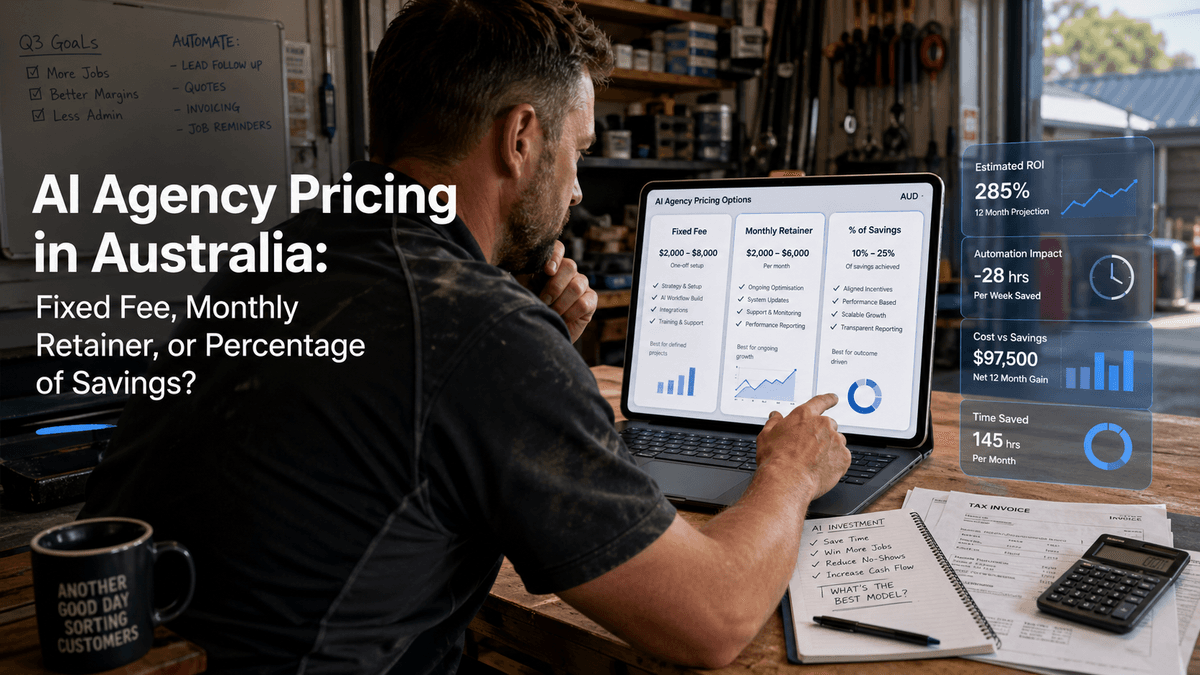
You ask three AI agencies for a quote. One sends a fixed project fee. One quotes a monthly retainer. One talks about sharing in the savings they deliver. The numbers look completely different and you have no way to compare them.
This is one of the most common problems businesses face when trying to hire an AI automation agency. The pricing models are genuinely different, not just cosmetically. Each one allocates risk, cost, and responsibility differently. Choosing without understanding how they work means you may be comparing entirely different things.
This article breaks down how each model works, what it typically costs for an Australian small business, and how to work out which one suits your situation before you sign anything.
Quick answer
There are three main pricing models for AI automation agencies: a fixed project fee for the build, a monthly retainer for ongoing support, and a combination of both. Two less common models worth knowing are time and materials billing and percentage of savings arrangements. For many Australian small businesses hiring an agency for the first time, the fixed fee plus retainer is often the most practical structure. The number to compare between quotes is the total year-one cost, not just the headline figure.
The five pricing models, explained
1. Fixed project fee
The agency charges a one-time fee to scope, design, and build a specific automation or set of workflows. Once the build is complete, the engagement ends unless you arrange something further.
This model is clean and predictable. You know what you are paying before work starts. It suits businesses with a clearly defined problem and a specific workflow to automate.
The main risk is that it does not include ongoing support. If the automation breaks after delivery, if a connected tool updates, or if outputs start drifting, that is your problem unless you have arranged a separate support agreement.
AUD planning range: First projects for small businesses often fall between AUD $3,000 and $15,000 depending on workflow complexity and number of integrations. More complex builds or multi-system projects can run higher. Treat this as rough orientation, not a quote.
2. Monthly retainer
The agency charges a recurring monthly fee to provide ongoing services. What this covers varies significantly between agencies and must be confirmed in writing before you sign.
Retainers suit businesses that need continuous management, regular updates, or ongoing build work rather than a single project delivered once.
The risk with retainers is vagueness. A retainer is only useful if you know exactly what is included and what gets billed separately. A well-scoped retainer is valuable. An open-ended one can be expensive and produce little.
AUD planning range: Retainers for small business scope work from AI automation agencies can range from a few hundred dollars per month for light monitoring to several thousand per month for active management and ongoing development. Confirm scope in detail before committing.
3. Fixed fee plus retainer (most common)
The agency charges a project fee to build the automation and a separate monthly retainer for ongoing support, monitoring, and maintenance. This is a common and often practical structure for Australian small businesses hiring an AI automation agency.
The build is delivered under the fixed fee. The retainer keeps it running. These are two separate costs and need to be modelled together to understand what you are actually paying. The year-one total cost modelling section below covers this in detail.
4. Time and materials
The agency bills by the hour or by the day. The total cost depends on how many hours the project takes.
Some AI automation providers may charge hourly or day rates, often varying widely depending on seniority, scope, and whether the work is strategy, implementation, or support.
This model can work for clearly scoped, short engagements where requirements are unlikely to change. It becomes risky when scope is loose, because time and materials billing has no ceiling unless one is contractually agreed upfront.
If you accept this model, insist on a capped estimate and a clear change management process before work begins.
5. Percentage of savings or ROI-share
The agency charges a lower base fee, or sometimes no upfront fee, and instead takes a percentage of the measurable cost savings or additional revenue the automation generates.
This model is designed to align the agency's incentives with your outcomes. If the automation delivers real savings, the agency earns more. If it does not, they earn less or nothing.
It sounds appealing, but it carries significant practical risks for small businesses:
Baseline measurement must be agreed before the project starts. Without a clear baseline, there is no way to calculate what the automation actually saved.
Attribution is difficult. Did revenue go up because of the automation, or because of other factors? This can become a dispute.
Contract terms need to be precise. What percentage? For how long? What counts as a saving? What is excluded?
Reporting must be transparent. You need to be able to verify the figures the agency uses to calculate their share.
This model can work when both parties trust each other, the process is measurable, and the contract is specific. For a first engagement with an agency you have not worked with before, it introduces complexity that may not be worth it. Approach it with careful legal review if you are considering it.
Pricing model comparison at a glance
Fixed project fee: one-time cost, predictable budget, no ongoing support included unless arranged separately. Suited to clearly defined single projects.
Monthly retainer: recurring cost, ongoing relationship, scope varies widely, must confirm what is included. Suited to businesses needing continuous management or development.
Fixed fee plus retainer: build cost plus ongoing monthly cost, most common structure for Australian SMBs. Year-one total is the right number to compare, not just the build fee.
Time and materials: hourly or daily billing, total cost depends on hours used, no ceiling unless contractually agreed. Suited to short well-scoped engagements. Risky if scope is loose.
Percentage of savings or ROI-share: lower or no upfront cost, agency earns from measured outcomes. Requires agreed baselines, clear attribution, and precise contract terms. High complexity. Suited to measurable processes with trusted providers.
Year-one total cost modelling
This is the section most agency pricing content skips, and it is the most important one.
Comparing a $5,000 fixed fee quote against a $1,500 per month retainer quote is not a meaningful comparison. You need to model what each option costs across twelve months to understand what you are actually deciding between.
The figures below are illustrative planning ranges based on Australian SMB market data available at the time of writing. They are not quotes, not guarantees, and will vary significantly depending on what you are automating, which agency you use, and what the scope includes. Use them to understand relative cost, not as a budget.
Scenario: a small business automating a single core workflow, such as lead intake, job scheduling, or customer follow-up
Fixed project fee only Build cost in the range of AUD $5,000 to $12,000. No retainer. Year-one cost is the build fee. After delivery, maintenance, fixes, and updates are your responsibility or billed separately as they arise. This is the lowest-cost option on paper and the highest-risk option in practice.
Fixed project fee plus light retainer Build cost of AUD $5,000 to $12,000 plus a monthly retainer in the range of AUD $400 to $1,000 for monitoring and maintenance. Year-one total: approximately AUD $9,800 to $24,000 depending on where in the range each figure sits.
Fixed project fee plus active retainer Build cost of AUD $5,000 to $12,000 plus a monthly retainer in the range of AUD $1,000 to $2,500 for active management, prompt reviews, integration updates, and reporting. Year-one total: approximately AUD $17,000 to $42,000.
Retainer-only model Agency builds incrementally and manages everything under a single monthly fee in the range of AUD $2,000 to $4,000. Year-one total: approximately AUD $24,000 to $48,000. Higher ongoing cost, but no large upfront investment.
Time and materials Variable. For a single workflow build, an estimate of 60 to 80 hours of work multiplied by the applicable rate. Can be cost-effective for a well-scoped project. Can run significantly over if scope is not controlled.
The point of this modelling is not to suggest one option is cheaper. It is to show that the difference between a fixed fee only arrangement and a fixed fee plus active retainer arrangement over twelve months is often AUD $15,000 to $30,000 or more. That is not a minor line item. Ask for the full year-one cost estimate before accepting any quote.
Which pricing model suits which situation
Fixed project fee suits you if:
The workflow to automate is clearly defined before the project starts
You have internal capacity to manage and maintain the system after delivery
You want a contained, one-time cost with no ongoing commitment
Monthly retainer suits you if:
You want ongoing development and management without a large upfront cost
You do not have internal technical capacity to keep the system running
You are comfortable with a recurring commitment over a defined period
Fixed fee plus retainer suits you if:
You want a defined build delivered upfront with support managed on an ongoing basis
You want cost certainty on the build and a clear scope on what the retainer covers
This is your first AI automation project and you want the agency to keep it running
Time and materials suits you if:
The project is short and the scope is well-documented before work starts
You want to avoid paying a premium for a fixed fee when the work is straightforward
You have agreed a cap on total hours in the contract
Percentage of savings suits you if:
The process being automated has a measurable, agreed baseline established before the project starts
You have independent legal review of the attribution methodology and contract terms
You have an existing relationship with the agency and trust the measurement and reporting process
What the retainer actually covers
Ongoing retainers are not a problem. For most small businesses, having an agency maintain the automation after the build is the right call. AI automations break when connected tools update, prompts drift as models change, and workflows need adjusting as business processes evolve.
The problem is not retainers. The problem is vague retainers.
Before agreeing to any retainer, ask for a written breakdown of what is included and what is not. The gap between assumed and actual scope is where most disputes originate.
What a retainer typically includes:
Monitoring for workflow failures and downtime alerts
Minor prompt adjustments and output quality reviews
Updates when connected tools change their APIs or interfaces
Monthly reporting on workflow performance
A defined number of support hours or fix events per month
What is typically billed separately:
Building new workflows or automations not covered in the original scope
Integrating with new tools added after the build is complete
Significant data cleanup or restructuring required by a workflow change
Major prompt overhauls following a model update from an AI vendor
Strategy work, roadmap planning, or new discovery sessions
Any work that exceeds the monthly support hours cap
None of this is unreasonable. Agencies cannot absorb unlimited change for a fixed monthly fee. The issue arises when a business signs a retainer assuming it covers everything, then receives separate invoices for work they assumed was included.
Get the retainer scope in writing before the build begins, not after.
Questions to ask before agreeing to any pricing model
What is the total estimated cost for year one, including the build, retainer, tool licences, and any likely additional work outside the quoted scope?
What is included in the retainer and what gets billed separately?
Who owns the automations, workflows, and code once the build is complete?
What happens to pricing if the scope changes during the build?
If I end the retainer after the build, what access do I retain to the systems you have built?
How do you handle integration maintenance when a connected tool updates?
If we are working on a time and materials basis, is there a cap on total hours?
Question three matters more than most buyers realise. Some agency agreements can leave ownership, access, or handover terms unclear, which can create lock-in later. Confirm the terms in writing before signing.
Red flags in how an agency presents its pricing
Watch for these before you commit:
Refusing to give any pricing range until after multiple meetings. A competent agency should usually be able to provide a rough range after one clear conversation about scope, even if the final quote requires discovery.
Presenting a fixed project fee with no mention of what happens after delivery.
A retainer quoted without a written scope of what is included.
References to ongoing support with no definition of what that means in practice.
A percentage-of-savings proposal with no agreed baseline or attribution methodology.
No mention of who owns the automations, code, or data configurations after the build.
A quote that does not separate the build cost from the ongoing cost, making year-one comparison impossible.
A good agency will answer questions about these directly and in writing. An agency that cannot or will not is showing you something about how the engagement will go.
Estimate your return before you commit to any pricing model
Before agreeing to any pricing structure, run the numbers on what the automation should return. If the build plus year-one retainer comes to AUD $20,000, what does the workflow need to save or generate to justify that cost?
Estimate your AI automation ROI before you commit
If you want help finding a provider, use Find AI Now to explore AI automation provider options and request support from providers who can scope the full cost before you commit.
Explore AI automation providers in Australia
For more due diligence questions, read Find AI Now’s guide on how to vet an AI agency before you commit.
View agency vetting guidance
FAQ
Is a fixed fee or a monthly retainer better for a small business?
For a first AI automation project, a fixed project fee with a clearly scoped retainer for post-build support is often one of the most practical structures. The fixed fee gives you cost certainty on the build. The retainer keeps the system running. The key is to model both together as a year-one total, not to compare the headline figures in isolation.
What does an AI automation retainer actually include?
It depends on the agency and the agreement. A retainer should cover monitoring, minor maintenance, integration updates when connected tools change, and a defined level of support hours. It typically does not cover new workflow builds, major scope changes, or work beyond an agreed monthly support limit. Ask for a written scope before signing.
How do I know if an AI agency quote is reasonable in Australia?
There is no fixed benchmark, and any pricing figures available publicly are planning ranges at best. A practical test is whether the total year-one cost is proportionate to what the automation is expected to save or generate for your business. If the agency cannot explain the expected return, that is worth pressing before you commit.
What is a percentage-of-savings pricing model and should I consider it?
A percentage-of-savings model means the agency earns a share of the measurable cost savings or revenue the automation generates rather than a fixed fee. It can align incentives well when structured properly, but it requires agreed baselines before the project starts, clear attribution methodology, transparent reporting, and precise contract terms. For a first engagement with an agency you do not know well, the complexity often outweighs the appeal. Get legal review of the terms before agreeing.
Can I negotiate AI agency pricing?
Yes. Scope, payment terms, retainer inclusions, and support hours are all negotiable. What is harder to negotiate is quality. A significantly below-market quote is worth scrutinising rather than accepting quickly. Ask what is excluded to understand how the price was reduced.
What happens if I need changes after the build is complete?
Under a fixed project fee with no retainer, additional work is typically billed separately, either at a day rate or as a new project quote. Under a retainer, minor changes may be included depending on the agreed scope. Major changes, new workflows, or new integrations are usually billed separately regardless of pricing model. Clarify the change management process before the build begins, not after.
The best pricing model is not the cheapest one. It is the one where the scope, support, risks, ownership, and expected return are clear before you sign.