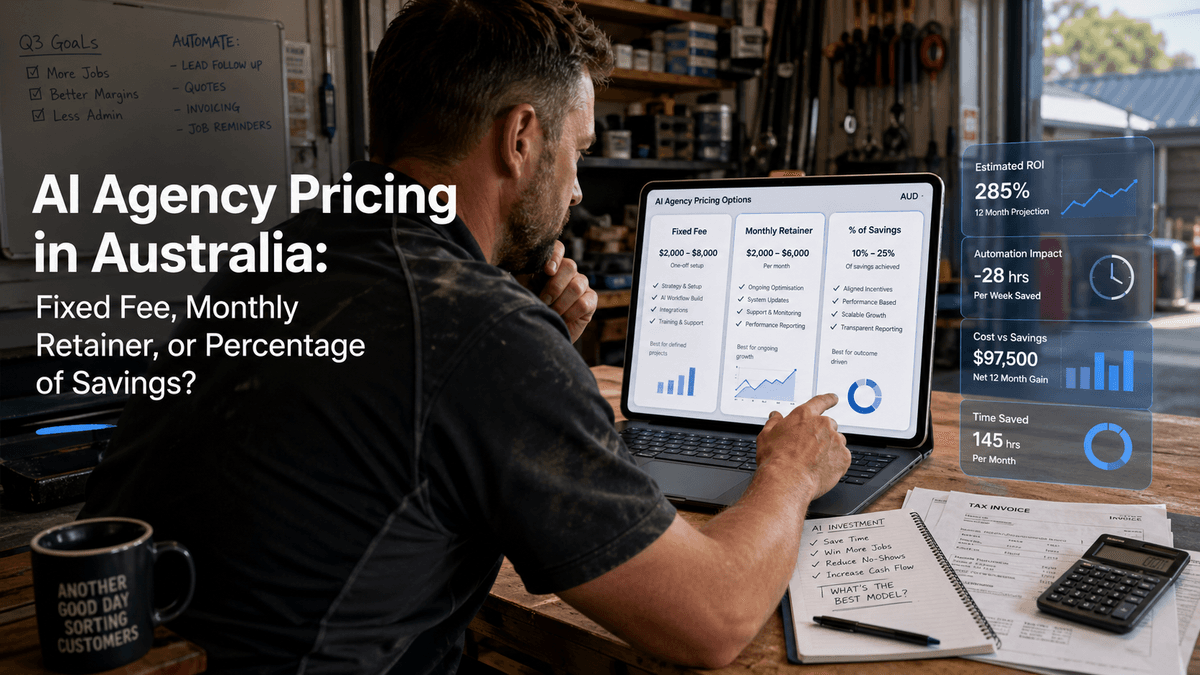
You have a workflow you want to automate. You have looked at tools that cost $50 to $300 per month. You have also been pitched by an AI agency that quoted you $8,000 to build it.
The numbers are not comparable, and most articles on this topic do not help you decide. They tell you "it depends" and then list features. That is not a decision framework. That is a hedge.
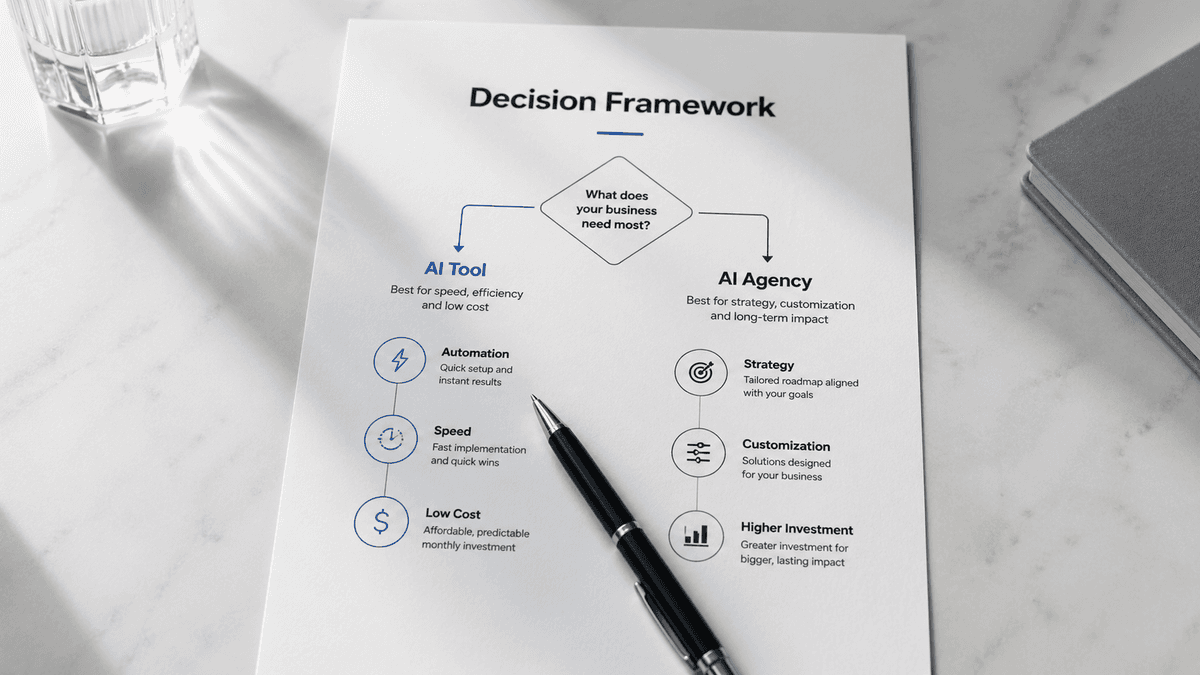
This article gives you specific criteria to work out which option fits your situation: tool, tool with help, agency build, or ongoing agency retainer. The right choice depends on workflow complexity, your internal capacity, the risk if it goes wrong, and what the real twelve-month cost looks like once everything is included.
Quick answer
If you have one clear workflow, clean data, internal technical capacity, and a low cost of failure, an AI tool is usually enough. If you have multiple integrations, messy data, no internal owner, compliance requirements, or a workflow that costs you money when it breaks, agency support is usually worth considering. The middle ground (tool with paid setup help, or tool now and agency later) suits most Australian small businesses. Compare year-one total cost, not the headline monthly fee, before deciding. If the workflow touches revenue, customers, compliance, or multiple systems, do not decide on subscription price alone.
The four options, not two
Most articles compare two options: DIY tool versus AI agency. That framing is too narrow and forces a false choice. There are four realistic options for a small business.
Option 1: DIY AI tool You buy a tool, configure it yourself, and run it without external help. Lowest upfront cost. Highest internal time investment. Works when the workflow is straightforward and someone on your team has the patience and capability to set it up and keep it running.
Option 2: AI tool with one-off setup help You buy the tool but pay a freelancer or specialist to configure it for you. The tool is yours. The setup is done by someone who knows what they are doing. After delivery, you run it yourself. Often a strong middle path that gets ignored.
Option 3: AI agency build You hire an agency to scope, design, build, and deliver a custom automation. They use the tools that suit your situation rather than locking you into one platform. Higher upfront cost, more capability, less of your time required during the build.
Option 4: Ongoing agency retainer The agency builds and continues to manage, maintain, and develop the system over time. Highest ongoing cost. Lowest internal management burden. Suits businesses that want continuous support and do not have an internal owner for the system.
The decision is not "tool or agency." It is which of these four options fits your workflow, your team, and your risk profile.
Decision matrix: how the four options compare
DIY AI tool Best for: simple, single workflows with low integration needs. Cost level: lowest upfront, lowest ongoing tool fees. Internal capacity required: high. Time to value: longest if you are learning the tool from scratch. Ongoing risk if it breaks: entirely yours to fix.
AI tool with one-off setup help Best for: a defined workflow you want set up properly without committing to ongoing fees. Cost level: low upfront tool plus a one-time setup fee. Internal capacity required: medium. You run it after delivery. Time to value: short to medium. Ongoing risk if it breaks: yours, unless the freelancer is available for paid fixes.
AI agency build Best for: workflows with multiple integrations, complex logic, or high cost of failure. Cost level: significant upfront build fee, no ongoing retainer. Internal capacity required: medium. You manage the live system after delivery. Time to value: medium. The build phase takes longer than a tool setup. Ongoing risk if it breaks: yours unless support is arranged separately.
Ongoing agency retainer Best for: business-critical workflows you cannot afford to manage internally. Cost level: highest year-one total cost across all four options. Internal capacity required: lowest. Time to value: medium for the initial build, then continuous improvement. Ongoing risk if it breaks: covered under the retainer scope.
A DIY tool is genuinely the right answer if all of these apply:
The workflow is well-defined and does one main thing
The tool you are looking at integrates natively with the systems you already use
Your data is clean and structured enough to drop into the tool with minimal preparation
Someone on your team has time, patience, and basic technical confidence to learn the tool
The cost of the workflow failing for a few hours is low
The volume is predictable and unlikely to grow rapidly
If all six of these are true, do not hire an agency to do something a tool will do. You will pay several thousand dollars for a problem that did not need that level of investment.
Common workflows that fit this category include simple lead capture into a CRM, basic email triggers, internal notification automations, and single-channel customer follow-ups.
When an agency makes sense
Hiring an agency is usually the right call when one or more of these apply:
The automation needs to connect to more than three different systems
Your data is inconsistent, unstructured, or spread across multiple sources
The workflow is part of a customer-facing process where errors damage trust or lose revenue
Compliance, privacy, or regulatory requirements apply (legal, medical, financial)
Nobody on your team has the time or capability to manage the build
The workflow involves judgment, exception handling, or branching logic that goes beyond simple if-then rules
You are automating something that, if it fails, costs you measurable money or customers
If two or more of these apply, the agency cost is usually justified by the cost of getting the build wrong with a DIY approach.
Common workflows that fit this category include AI receptionist setups for service businesses, lead qualification across multiple channels, document processing for regulated industries, and integrated quote-to-invoice automations.
When a hybrid setup is best
Most Australian small businesses fall into one of two hybrid scenarios. These are often the smartest options, even though they get the least coverage in tool vs agency content.
Tool with paid setup help You buy a tool you can manage yourself, but pay a specialist or freelancer to configure it properly at the start. You avoid the ongoing retainer cost while still getting the build done by someone who has done it before. Suits businesses with one or two workflows that are slightly too complex for a complete DIY approach.
Tool now, agency later You start with a single workflow on a tool, run it yourself, and bring in an agency only when complexity grows or a second more critical workflow appears. This staged approach is often the most cost-effective path, though it requires honesty with yourself about when you have outgrown the tool.
The mistake is going straight to either extreme. Going full agency for a workflow a tool would handle wastes money. Going full DIY for a workflow that needs an agency wastes more.
Complexity threshold checklist
Use these as concrete triggers. Each "yes" pushes the decision toward agency help.
Does the workflow connect to more than three external systems?
Does it involve customer data covered by privacy regulations?
Is there a measurable cost (in revenue, time, or trust) when it fails?
Does it require handling of unusual or exception cases beyond simple rules?
Will multiple stakeholders need to approve scope and changes?
Does it depend on data that is currently messy, inconsistent, or in PDFs?
Is the volume expected to grow significantly in the next twelve months?
Does it need to comply with industry-specific standards or contractual obligations?
If you answered yes to one or two of these, a tool with setup help is often the right answer. If you answered yes to three or more, an agency build is usually worth considering. If you answered yes to five or more, an ongoing retainer is worth considering.
AUD year-one cost comparison
This is the section most articles on this topic skip, and it is the most important one. The comparison most readers make in their head is "tool subscription versus agency build fee." That is the wrong comparison. Compare the full year-one cost for each option.
The figures below are illustrative planning ranges based on Australian SMB market context at the time of writing. They are not quotes. Use them to understand relative cost, not as a budget.
DIY AI tool Tool subscription: AUD $50 to $300 per month, equating to AUD $600 to $3,600 per year. Add staff time for setup and ongoing management, which can be significant in the first three months. Year-one total: roughly AUD $600 to $3,600 in tool cost plus internal staff time. Real cost depends heavily on how much time your team puts in.
AI tool with one-off setup help Tool subscription as above, plus a one-time setup fee in the range of AUD $1,500 to $5,000 depending on workflow complexity. Year-one total: roughly AUD $2,100 to $8,600.
AI agency build, no retainer Build fee in the range of AUD $5,000 to $15,000. No retainer. Maintenance and fixes billed separately as they arise. Year-one total: roughly AUD $5,000 to $15,000, plus any post-build fixes.
AI agency build with light retainer Build fee of AUD $5,000 to $15,000 plus a monthly retainer in the range of AUD $400 to $1,000. Year-one total: roughly AUD $9,800 to $27,000.
AI agency build with active retainer Build fee of AUD $5,000 to $15,000 plus a monthly retainer in the range of AUD $1,000 to $2,500. Year-one total: roughly AUD $17,000 to $45,000.
The difference between the lowest-cost path and the highest-support path can be tens of thousands of dollars across twelve months. That is not a small line item. The right comparison is which option delivers the right outcome for your situation, not which has the lowest sticker price.
How hidden costs change the decision
The DIY tool option looks cheapest on paper. It often is not, once you account for what is genuinely hidden in that approach.
Tools require ongoing prompt adjustments as AI models update. Connected systems update their interfaces and break the automation, which then needs fixing. Exception handling, the cases the tool cannot manage, falls entirely to your team. Tool licence tiers can jump as usage grows. None of this is included in the monthly subscription fee.
The hidden costs of AI automation are not theoretical. They are real, ongoing, and predictable. Before assuming a $100 per month tool is cheaper than a $10,000 agency build, calculate what it actually costs across twelve months including the hidden labour and maintenance burden.
For a full breakdown of the costs that get missed in cheap-looking quotes, see the article on the hidden costs of AI automation.
The framing matters: hidden costs do not disappear when you choose a tool over an agency. They move from the agency's invoice to your team's calendar.
Estimate the real return before deciding
Before committing to any option, run the numbers on what the workflow needs to save or generate to justify the year-one cost.
Estimate your AI automation ROI
If the framework points toward agency help, request help finding a suitable AI automation provider through Find AI Now and ask for a scoped quote that covers the full year, not just the build.
Explore AI automation provider options in Australia
For more detail on what to ask once you start speaking with providers, the AI agency pricing article covers how to compare quotes properly.
See how AI agency pricing actually works in Australia
FAQ
Is it cheaper to use an AI tool or hire an AI agency for a small business?
The tool is usually cheaper on paper. It is not always cheaper in reality. Once you factor in the time to set it up, the time to manage it, the cost of fixing it when integrations break, and the staff time spent handling cases the automation cannot, the gap narrows. For simple workflows, the tool wins on cost. For complex or business-critical workflows, the tool can end up costing more than an agency once everything is counted.
When should a small business hire an AI agency instead of building with a tool?
When the workflow connects to multiple systems, involves customer-facing risk, requires exception handling, depends on data that needs cleaning first, or has compliance considerations. Also when nobody internally has the time or capability to build and maintain it. If two or more of these apply, agency support is usually worth considering.
Can I start with a tool and bring in an agency later if it gets complicated?
Yes, and this is often the best path for businesses with limited initial budget. Start with a single, low-risk workflow on a tool. If it works and the volume justifies expansion, bring in an agency for the next workflow rather than retrofitting the first one. The trade-off is that you may need to rebuild the original workflow if the agency uses different infrastructure, so think about whether the initial setup is genuinely throwaway or worth preserving.
What level of technical capability do I need internally to manage a DIY AI tool setup?
You need someone who is comfortable with software, can read documentation, has patience for trial and error, and has time available to learn. They do not need to be a developer. They do need to be willing to keep the system running, fix it when integrations change, and adjust prompts when outputs drift. If nobody on your team has both the capability and the time, DIY is not the right choice regardless of how cheap the tool looks.
Are AI automation agencies worth it for a single workflow?
Sometimes. If the single workflow is business-critical, complex, or sits in a regulated industry, then yes. If it is a simple workflow with low risk, paying agency rates for a single piece of work is usually overpayment. A tool with one-off setup help is often the more sensible middle ground.
What happens if I outgrow my AI tool, do I have to start from scratch with an agency?
Not always. A capable agency will assess what you have built, identify what is reusable, and rebuild only what needs rebuilding. The risk is greater if your tool setup is heavily customised in ways the agency cannot easily migrate. Ask early whether your existing workflow is reusable before agreeing to a full rebuild.
The right choice is not the cheapest option. It is the option that matches the workflow complexity, internal capacity, risk level, and expected return.