Most Australian real estate agencies have already been pitched AI automation by at least one vendor. Most have not committed because the demos sound good but the path forward is unclear.
The right question is not "should we use AI." It is "which workflow should we automate first, what should we leave alone for now, and how much should it cost?"
This article gives you a clear answer for an Australian agency, written without selling a specific product. The recommendations are based on which workflows generate revenue, which ones cost you most when they go wrong, and which ones are realistic for an agency to implement without disrupting the team.
Quick answer
For most Australian real estate agencies, the first workflow to automate is inbound lead response capture, connected directly to your existing CRM. This is the workflow with the highest revenue at risk, the most predictable inputs, and the fastest payback. A first project typically sits in the range of AUD $5,000 to $15,000 for setup with ongoing costs from a few hundred to a few thousand dollars per month, depending on the setup model. Vendor relationship calls, buyer negotiations, and pricing conversations should not be the first thing you automate.
Why lead response speed matters in real estate
The relationship between response time and lead capture is well established in real estate. When an enquiry comes in, the agency that responds first usually has the best chance of converting it. Faster response usually improves lead capture. Delays reduce your chance of winning the enquiry, especially for new buyers or renters checking multiple agencies at once.
The hardest part of this is structural. Most enquiries do not arrive between nine and five on a weekday. They arrive in the evening, on weekends, between inspections, and while the agent is in the middle of another conversation.
Most agencies do not lose enquiries because the agent is incompetent. They lose them because the agent is busy or asleep when the enquiry comes in. AI automation does not replace the agent. It removes the gap between the enquiry arriving and the first response.
The real estate workflows worth automating
Most Australian agencies have a similar list of candidate workflows for automation. The ones with the strongest case are below.
Inbound listing enquiries. Web form submissions, portal enquiries, and phone leads about specific listings. Predictable inputs, structured outputs, high revenue at risk per enquiry.
Buyer enquiries. General buyer interest enquiries that need qualification and routing. Suits structured intake and qualification.
Rental enquiries. Often the highest volume of inbound enquiries, particularly for property managers. Repetitive questions about availability, viewing times, application processes, and pet policies.
Inspection booking. Booking and confirmation workflows that follow a predictable pattern.
Vendor follow-up. Post-listing communication with sellers about marketing, enquiries, inspection numbers, and feedback.
Appraisal follow-up. Following up with property owners after an appraisal to maintain relationship and capture future listings.
CRM data updates. Capturing notes, updating contact records, logging interactions. The least exciting workflow and one of the most valuable to automate because it is the one agents skip when they are busy.
After-hours enquiry capture. Inbound enquiries that arrive outside business hours. The largest gap in most agencies.
Missed call and web form follow-up. Enquiries that came in but did not get a response within the agent's target window.
Not all of these should be automated immediately. The order matters more than the list.
The first workflow to automate
For most Australian real estate agencies, the first AI automation project should be inbound lead response capture for listing and buyer enquiries, connected to your existing CRM.
Here is what this looks like in practice. An enquiry comes in via your portal listings, your website form, or by phone. The automation acknowledges the enquiry instantly. It asks structured qualification questions: which property, intended budget range, timeline, are they looking to inspect, what is the best contact number. It logs the answers in your CRM. It books an inspection slot if the prospect wants one. Then it hands the enquiry to the agent for the relationship-building call.
The agent does the relationship work. The automation does the speed and capture work.
There are five reasons this is the right starting workflow:
Revenue at risk is highest. A single recovered listing or management opportunity can potentially justify a large part of the first-year automation cost, depending on commission, fees, attribution, and the final project cost. That is why lead response is one of the agency workflows closest to revenue.
Inputs are predictable. Property of interest, contact details, enquiry type, and inspection availability follow a structured pattern that AI handles reliably.
Integration is straightforward. Most Australian agencies already use a CRM (Rex, Agentbox, VaultRE, PropertyMe, or similar). These platforms are common targets for AI automation integrations, which means the path from enquiry capture to CRM record is well-trodden.
After-hours coverage is included by default. AI does not need different shift patterns. The largest gap in most agency lead response is automatically covered.
Payback is measurable. You can track enquiry volume, response time, and CRM completion rate before and after the automation. The numbers are visible.
The agent is not removed from the relationship. The agent is removed from the data entry and the speed problem. That is exactly what should be automated first.
What not to automate first
Some workflows are tempting to automate but should not be the first project. This is not a list of things AI can never do in real estate. It is a list of things that should not be your first attempt because the cost of getting them wrong is too high.
Vendor relationship calls. Vendor relationships are trust-driven. They depend on the agent's voice, judgement, and consistency over time. An automation that mishandles a vendor conversation can damage a relationship that took months to build.
Buyer negotiation conversations. The negotiation is where the agent earns the commission. Automating this layer is high stakes, judgement-heavy, and brand-defining. Get the lead response automation working first.
Appraisal conversations and pricing discussions. These are highly varied, involve nuanced market judgement, and often shape whether the listing comes in at all. The risk of an AI sounding generic or making a poor judgement is too high for a first project.
Contract review or any communication that could cross into legal advice. Handle this manually. Get specialist help if you need to scale this layer.
Listing copy and property descriptions where brand voice matters. AI can generate property copy, but using it as your first project means committing to a specific tone and style across every listing without testing the impact on enquiries first.
Complex investor relationship management. High-value, low-volume, judgement-heavy. Wrong workflow for a first AI project.
The pattern is the same across all of these. Start with the workflow closest to revenue, easiest to measure, and most painful when handled slowly. Expand from there.
The same decision framework that applies to AI automation generally also applies to real estate. The right approach depends on workflow complexity, your team's internal capacity, and the volume of enquiries involved.
A tool may be enough if: the workflow is simple, you have one or two staff who are comfortable configuring software, your CRM has native AI features that cover the basics, and your enquiry volume is predictable. Some Australian agencies start with a tool-based setup using their existing CRM's automation features and add AI on top.
An agency or provider build is usually worth considering when: the workflow connects to multiple systems (CRM, portal feeds, phone system, email), the data quality in your CRM is inconsistent and needs cleanup, you have no internal capacity to manage the build, or your agency runs multiple offices with different processes.
A hybrid setup often works best when: you want a tool for the simpler automations (inspection confirmations, basic enquiry routing) and a provider build for the more complex workflows (cross-channel lead response, after-hours enquiry handling with multiple integrations).
For a deeper breakdown of how to make this decision generally, see the AI tool vs AI agency decision framework.
AUD planning ranges for real estate AI automation
The figures below are illustrative planning ranges based on Australian market context at the time of writing. They are not quotes. Pricing varies significantly by provider, by scope, and by which CRM and systems you are integrating.
Tool-based setup using existing CRM features and lightweight AI: AUD $50 to $300 per month for tool subscriptions, plus internal staff time to configure. Suits agencies with one office, a small team, and a willingness to manage the setup themselves.
Provider-configured build for a single agency: AUD $5,000 to $15,000 setup, plus ongoing tool licences and an optional retainer. Year-one cost typically sits in the AUD $10,000 to $25,000 range depending on the level of ongoing support. Suits most independent and boutique Australian agencies as a first project.
Agency build with active retainer for multi-office or franchise operations: AUD $10,000 to $30,000 setup plus an active monthly retainer. Year-one cost typically AUD $20,000 to $50,000 or more. Suits larger agencies with multiple offices and more complex integration requirements.
For a fuller breakdown of how AI agency pricing structures work in Australia, see the AI agency pricing article. For a guide to the costs that often get missed in initial quotes, see the hidden costs of AI automation.
Risks specific to real estate
Real estate AI automation has a few risks that general automation content does not address. These are practical considerations to raise with any provider before you sign anything.
Brand voice. Real estate agents have personal brands. The tone an automation uses to respond on the agent's behalf matters. A generic, vendor-sounding automation can damage the agent's brand without anyone noticing for months. Ask any provider how the system represents the agent and whether the tone can be tuned.
Vendor and buyer data. Agencies hold sensitive contact information, financial details, and listing data for vendors and buyers. Before signing with an automation provider, ask where customer data goes, who can access it, how it is stored, and whether any of it is used to train AI models. These are questions to ask, not legal conclusions, and a credible provider will have clear answers.
Compliance and consumer-facing communication. Real estate is a regulated industry in every Australian state. Marketing claims, listing accuracy, and enquiry responses can all create compliance exposure if handled poorly. The first automation should be designed not to make commitments on behalf of the agent that could create issues later.
The cost of a bad automation on a high-value enquiry. A mishandled call to a $50 enquiry costs you a $50 problem. A mishandled response to a vendor considering a $1.2 million listing costs you the listing. The stakes per enquiry are higher in real estate than in many other industries, which is why the first project should be focused, well-scoped, and tested before scaling.
Where AI receptionist fits
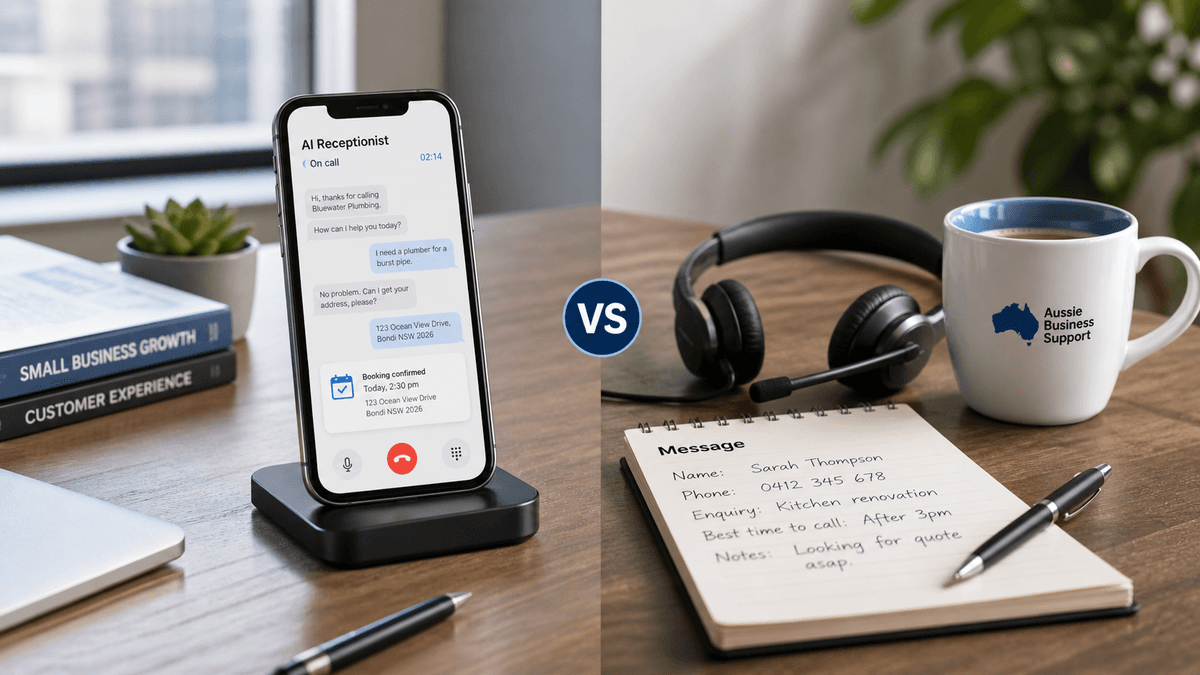
Many Australian agencies considering AI automation will also be looking at AI receptionist solutions for phone coverage. These are complementary, not the same thing.
A real estate AI automation typically focuses on web form enquiries, portal enquiries, and CRM workflows. An AI receptionist focuses on phone enquiries and after-hours phone coverage. Most agencies eventually use both.
The recommendation for most Australian agencies is to start with lead response automation for digital enquiries first, since web and portal enquiries are typically the higher volume channel for buyer leads. Add an AI receptionist layer once the first project is running and you have data on phone enquiry volume.
For more on the receptionist decision, see AI receptionist vs virtual receptionist and the AI receptionist cost article.
How to calculate whether real estate AI automation pays for itself
A simple framework for an Australian agency.
Step one: estimate your monthly enquiry volume. Web form submissions, portal enquiries, and phone enquiries combined. Use last quarter's data if you have it.
Step two: estimate your current capture rate. Of those enquiries, how many get a response within an hour? How many get a response at all? Most agencies underestimate this gap until they actually look.
Step three: estimate your conversion rate from a captured enquiry. What percentage of properly responded enquiries become a listing, a buyer relationship, or a rental application?
Step four: estimate the value of a converted enquiry. For sales, this is the average commission per transaction. For rentals, this is the value of the management fee plus letting fee. For property management, this is the lifetime value of a managed property.
Step five: calculate the revenue at risk. Monthly enquiries multiplied by current loss rate multiplied by conversion rate of properly handled enquiries multiplied by value of a converted enquiry.
Step six: compare against the year-one cost of the automation. If the recovered revenue exceeds the year-one cost by a meaningful margin, the automation pays for itself.
For a worked version using your specific numbers, use the Find AI Now ROI calculator.
Find AI Now verdict
For most Australian real estate agencies, the first AI automation project should be inbound lead response capture for listing and buyer enquiries, connected to the existing CRM.
The setup model that fits most independent and boutique agencies is a provider-configured build in the AUD $5,000 to $15,000 range, with a light monthly retainer for ongoing maintenance. Larger agencies and franchise networks often need a more substantial build with active ongoing support.
The single workflow to avoid making your first project is anything involving direct vendor communication, buyer negotiation, or appraisal conversations. These workflows can use AI eventually but should not be the first project.
For many agencies, a well-scoped first project can justify itself within six to twelve months if the team uses it consistently and the recovered enquiries are valuable enough. The agencies that struggle are usually the ones that automated the wrong workflow first or signed with a provider that did not set up the integration properly.
Estimate the return for your agency before you commit
Before signing with any provider, run the numbers on what the automation needs to recover to pay for itself in your specific agency.
Estimate your AI automation ROI
If you want help finding a suitable AI automation provider, explore the AI automation provider options on Find AI Now.
Explore AI automation provider options in Australia
For more context on how to choose between a tool-based setup and an agency build, see the decision framework article.
Should you use an AI tool or hire an AI agency?
FAQ
What is the first thing a real estate agency should automate with AI?
Inbound lead response capture for listing and buyer enquiries, connected to your existing CRM. This is the workflow with the highest revenue at risk, the most predictable inputs, and the fastest payback. The agent continues to handle relationship-building calls. The automation handles instant acknowledgement, qualification, and CRM logging.
How much does AI automation cost for an Australian real estate agency?
A typical first project for a single-office agency sits in the range of AUD $5,000 to $15,000 for setup, with ongoing costs from a few hundred to a few thousand dollars per month depending on the setup model. Year-one total often sits between AUD $10,000 and $25,000. Larger agencies and multi-office operations typically pay more. These are planning ranges, not quotes.
Can AI automation integrate with Rex, Agentbox, VaultRE, or PropertyMe?
Often, yes, but it depends on the provider, your account setup, API access, and the exact workflow being automated. These platforms are commonly used by Australian agencies and are common integration targets for AI automation providers. The detail and quality of the integration varies by provider. Ask any provider directly about how they integrate with the specific CRM you use, how they handle updates to that CRM, and who maintains the integration after launch.
Should a real estate agency use an AI tool or hire an AI agency?
It depends on the complexity of the workflow and your internal capacity. For simple lead response automation in a single office with a willing internal owner, a tool-based setup with your existing CRM and a lightweight AI layer can work. For multi-office operations, multiple integrations, or agencies without internal technical capacity, hiring a provider is usually worth considering. The AI tool vs AI agency decision framework covers this in detail.
Is AI safe to use for real estate enquiries given privacy and compliance considerations?
It can be, with the right setup. Before signing with any automation provider, ask where vendor and buyer data goes, who can access it, how it is stored, and whether any of it is used to train AI models. Also ask how the system is configured to avoid making commitments on behalf of the agent that could create compliance issues. These are practical questions to clarify with the provider before signing, not legal conclusions.
Will customers know they are interacting with AI when they enquire about a property?
In many cases, yes. Modern AI systems can hold a natural conversation but are usually identifiable as AI on close attention. Some providers configure the system to disclose that the first response is automated and that an agent will follow up. Others do not. Decide upfront how you want to position this for your brand, and make sure the provider builds the system to match.
How long does it take to set up AI lead response for a real estate agency?
A focused first project, scoped to inbound lead response with one CRM integration, typically takes between two and six weeks from kickoff to live operation. More complex builds with multiple integrations or multi-office configurations take longer. If a provider tells you they can have you fully live in 48 hours and your CRM data needs cleanup, that is worth questioning.
For most agencies, the first AI project should not be the flashiest one. It should be the workflow closest to revenue, easiest to measure, and most painful when handled too slowly.